Whole Life Carbon Assessment

With 40% of total national CO₂ emissions coming from the built environment, it’s high time to end the so-called carbon emission paradox: where energy savings achieved through insulation and more efficient systems simultaneously increase material-related emissions. This is particularly relevant given that building systems often need replacing every 15 years or so, meaning renewed extraction, transport and processing of increasingly scarce materials, with all the associated emissions.
New legislation
Why is our Whole Life Carbon Assessment important for you now? Firstly, the Energy Performance of Buildings Directive IV is on its way. This European legislation will require owners of buildings larger than 1,000 m² to carry out a Whole Life Carbon calculation from 2028 onwards. In addition, our assessment provides an excellent method not only to address Scope 1 and 2 emissions from gas and electricity use, but also to reduce Scope 3 emissions throughout your value chain.

De Lindenberg
For this cultural venue in Nijmegen, originally built in 1972, we conducted a feasibility study to explore how the building could be made future-proof. Our conclusions, including potential measures, now serve as input for further political decision-making.
Haskoning brought structure to the complexity. Every measure was substantiated and calculated in detail. This built confidence for further studies, broader than the usual routes.
Our approach
Our approach benefits all parties that own or use real estate, from investors with property portfolios to healthcare institutions, housing associations and municipalities. So what does our approach involve? The key is that we bring together all the necessary disciplines. From there, we help your organisation make the right decisions early in the process. The first question we ask is: what are your ambitions and objectives? From that starting point, we work backwards to determine what is needed to achieve your desired outcome. We use several tools to support this process, including:
- Workshops: Through a series of sessions, we help define your goals, the context of your real estate, and potential solutions.
- Scenario studies: Using computer models, we calculate thousands of variants where necessary, adjusting key parameters each time to minimise the environmental impact of your property and identify the most effective measures.
- Integrated feasibility study with site visit: For renovation projects, we assess the current state of the building and determine what’s required to make it future-ready.
That’s exactly what our Whole Life Carbon Assessment delivers: future-proof buildings. We consider not only emissions during the building’s operational life, but also those embedded in materials before and during construction. Sustainability naturally plays a central role, but we believe your building should also be a pleasant place to be, with enough daylight, comfortable temperatures and good acoustics. And, of course, we keep a close eye on costs. Our goal is to help you achieve your ambitions in a cost-effective way.
Rotterdam Waterkant
How can you develop 400,000 m² of housing sustainably? For this major urban development on the River Maas, near the Feijenoord Stadium, we carried out a scenario study to answer precisely that question.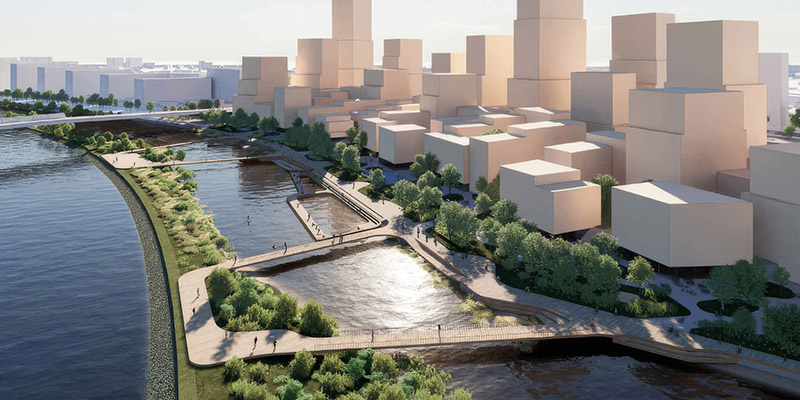
Collaboration across disciplines
Why choose Haskoning for a Whole Life Carbon Assessment? Firstly, what we design is genuinely feasible. Everything we propose is supported by solid data, enabling your organisation to make well-founded decisions. With extensive experience and in-house expertise, we bring together all the disciplines required, including:
- Architecture: How can we (re)design a building to its full potential?
- Structural engineering: What are you building or adapting, and is it technically achievable?
- Building physics: How can we make the building both sustainable and comfortable?
- Sustainability: Which materials should you use, and what is their environmental impact?
- Energy and building services engineering: Which energy-efficient systems are the best fit?
- Fire safety: What additional measures are needed, especially for timber structures?
Our experts are ready to help you move forward.