Unlocking energy supply for business parks

MaartenLaban

FoekeBoersma
Why the local context matters
The potential of an energy hub is highly dependent on its local context. A region’s suitability for developing an energy hub is influenced by several factors, including:
- Renewable energy output and electrification potential
- Grid topography and available capacity
- Flexible power demand potential
- High level of organisation and involved stakeholders
To assess this potential, we have developed a methodology based on Multi-Criteria Analysis (MCA): a decision-support tool that evaluates multiple factors to identify optimal solutions in complex scenarios.
Identifying promising locations for energy hubs
At the heart of our approach is MCA, which enables informed decision-making by weighing several criteria. These attributes are assessed and filtered to identify areas with strong potential for energy hub development. The analysis is illustrative and directional, designed to highlight promising locations and estimate their potential scale.
Criteria and assigned weights:
-
Net surface area of the business park [ha] – 3
- Current electricity consumption [MWh/year] – 6
- Difference in electricity peak before and after electrification [MW] – 6
- Expected charging demand for Battery Electric Vehicles (BEV) [MW] – 6
- Proximity to medium-voltage substation [km] – 1
- Added economic value [€] – 8
- Amount of SDE-supported generation within the MV area [MW] – 4
- Urgency of grid congestion in the MV area [year] – 6
Where energy hubs can make a difference
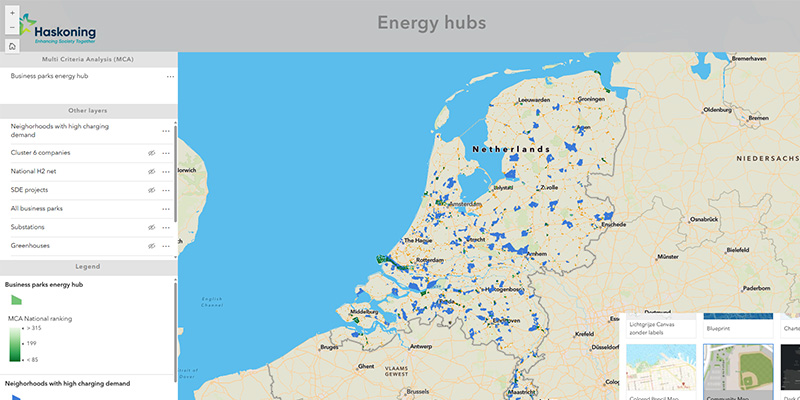
Our interactive map displays the top 400 business parks, ranked by their MCA score. For each promising hub, we highlight the added value, including:
- Reducing peak load on the electricity grid (MWe): Peak demand before and after electrification is calculated using standardised profiles, accounting for residual gas use during peak generation. This analysis does not compare individual measures to reduce peak demand.
- Avoided CO₂ emissions (tonnes/year): Emissions reductions are calculated based on gas savings through electrification, including savings achievable without further electrification. While electrification increases electricity consumption, it may also lead to additional CO₂ emissions. Energy hubs can help offset this by enabling more local renewable generation. These effects are detailed separately in the data.
Limitations and next steps
Our analysis takes a regional perspective and is not detailed enough for precise, case-specific predictions. This underscores the need for further studies to assess specific locations, confirm technical and economic feasibility, and compare collective versus individual measures.
The methodology was first applied in the study 'The Families of Energy Hubs in the Netherlands’, and later expanded for use in the provinces of North Holland and North Brabant. In both cases, the method was combined with bottom-up analyses of business parks and grid topology to identify promising locations for energy hub development.
Leading the way in energy hub solutions
We are at the forefront of energy hub implementation, having played a pivotal role in their successful deployment in the Netherlands. This includes identifying the essential technical and organisational building blocks needed for various energy hub types, and developing a tool to quantify and track societal benefits, including peak load reduction and carbon reduction, at regional and national levels.
Want to know more? Contact our experts or continue reading about energy hubs and learn how we can help your energy resilience by making new energy hubs a reality.

Contact our Energy experts
Have a question or business enquiry? Talk to one of experts to see how we can help.
Discover other blogs in the Energy Hubs series

 Sustainable society
Energy hubs: a solution to grid congestion and the path to net zero
Always up-to-date on latest energy insights?