SES Water reduces leakage-related disruption during a major cold snap
Project facts
- Client
- SES Water
- Location
- Redhill, United Kingdom
- Challenge
- Freezing conditions followed by a quick thaw can cause significant disruptions to water supplies. During the December 2022 cold snap, SES Water needed to identify and fix leaks quickly.
- Solution
- Twinn Aquasuite uses machine learning to identify anomalies in water patterns, enabling SES Water to drastically reduce its reliance on manual monitoring to detect leakages.
- Impact
- Twinn Aquasuite gave SES Water crucial information about the severity of water supply anomalies, allowing them to prioritise leaks for repair and minimise disruption during the unprecedented weather.
Twinn Aquasuite quantifies the size of the issue. Because of that, we were able to identify the bursts with the most significant impact to customers quickly and minimise interruption to supply.
The challenge
Preventing disruption from leakages caused by low temperatures
Despite being the warmest year on record, 2022 saw the UK experience its coldest December in over a decade. During the month, prolonged periods of low temperature – often accompanied by snow and ice – preceded a freeze-thaw event where temperatures rose by over 20°C within a short timeframe.
Drastic changes in temperature make soil expand and shrink, causing water pipe bursts and leakages. This tends to be more intense in areas like the south of England, which are unaccustomed to low temperatures. It can result in significant interruptions to water supply, as well as a reduction in water quality.
Against this backdrop, SES Water needed to mitigate disruption to the water distribution network and minimise the impact on its customers.
The solution
Leveraging machine learning to locate and prioritise critical areas
Prior to our involvement, SES Water analysts would manually check multiple data trends to look for an increase in water consumption that could be leak-related – a time-consuming daily task. They also leveraged information from customer calls.
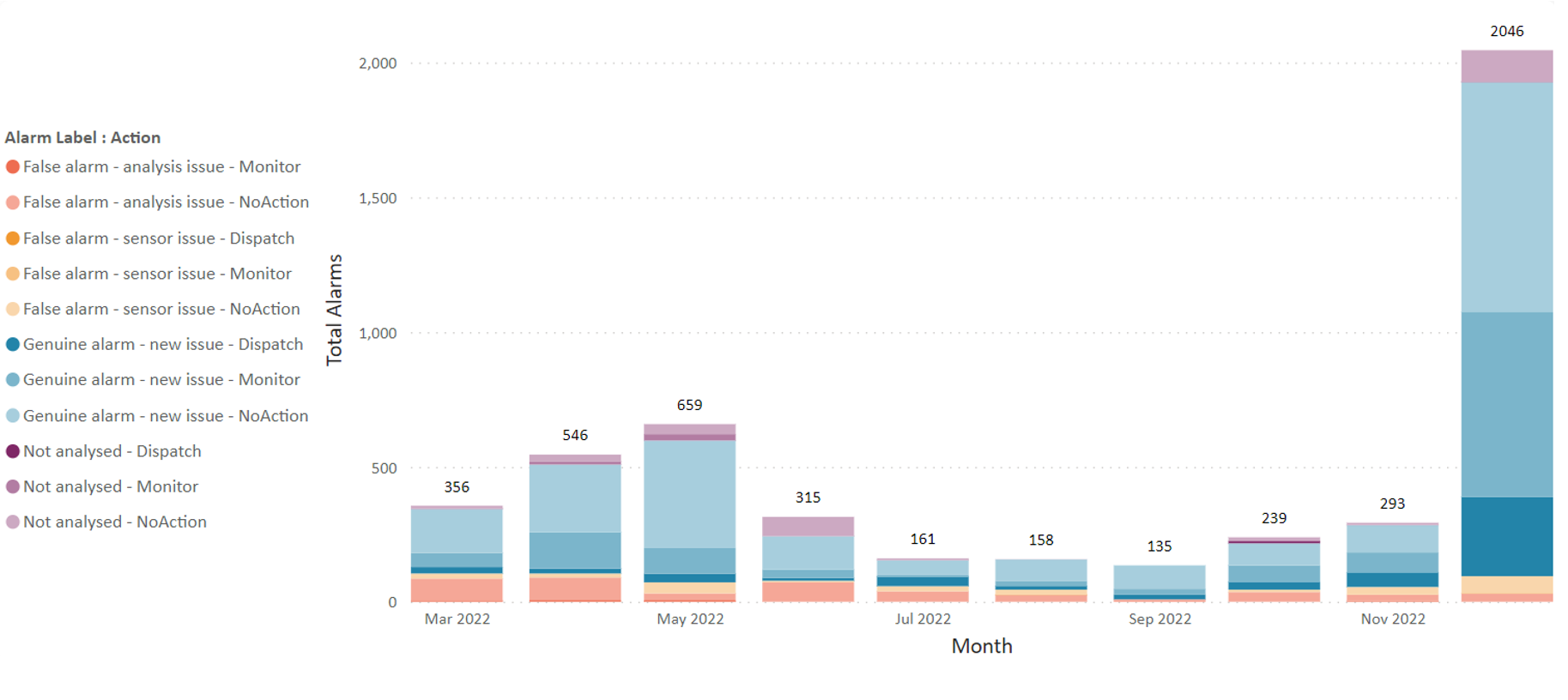
However, since starting to use Twinn Aquasuite in March 2022, SES Water can identify anomalies faster – improving their strategy for addressing leaks. Our machine learning models use data from around 300 flow sensors distributed over 300 district metering areas – providing a baseline for what’s ‘normal’ at each part of the network. Analysts and operators receive an average of 10 alarms per day based on analysis of the data. When potential leakages are identified, the SES Water team is sent to the field to address them.
As demonstrated by Figure 1 – which shows the number of alarms generated by Aquasuite along with their validity label – our solution identified anomalies in the distribution pipeline and alerted SES Water. This was particularly beneficial during the unprecedented conditions of December 2022.
The impact
Thanks to its collaboration with Aquasuite, SES Water was notified about network anomalies faster. During the intense pressure in December 2022, the alarms were a strategic source of information for identifying the most critical leaks.
As shown in Figure 2, there was a clear correlation between the increase in the number of alarms and the variation in temperature. Alarm numbers peaked at around 350 per day on 19 December 2022, when the minimum temperature rose from -2°C to 9°C, altering soil conditions extremely quickly.
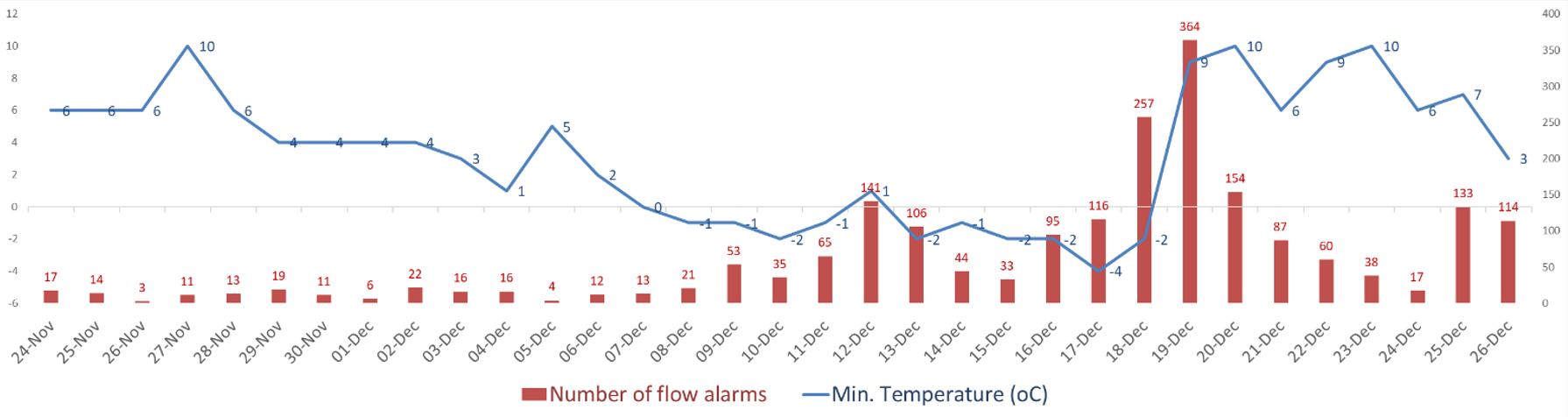
The number of alarms in December 2022 was nearly 7 times higher than the previous month, and 79% of the critical alarms were labelled genuine and in need of investigation. In addition, 84% of leaks teams found in the field between 9 and 30 December 2022 correlated to alarms in Aquasuite.
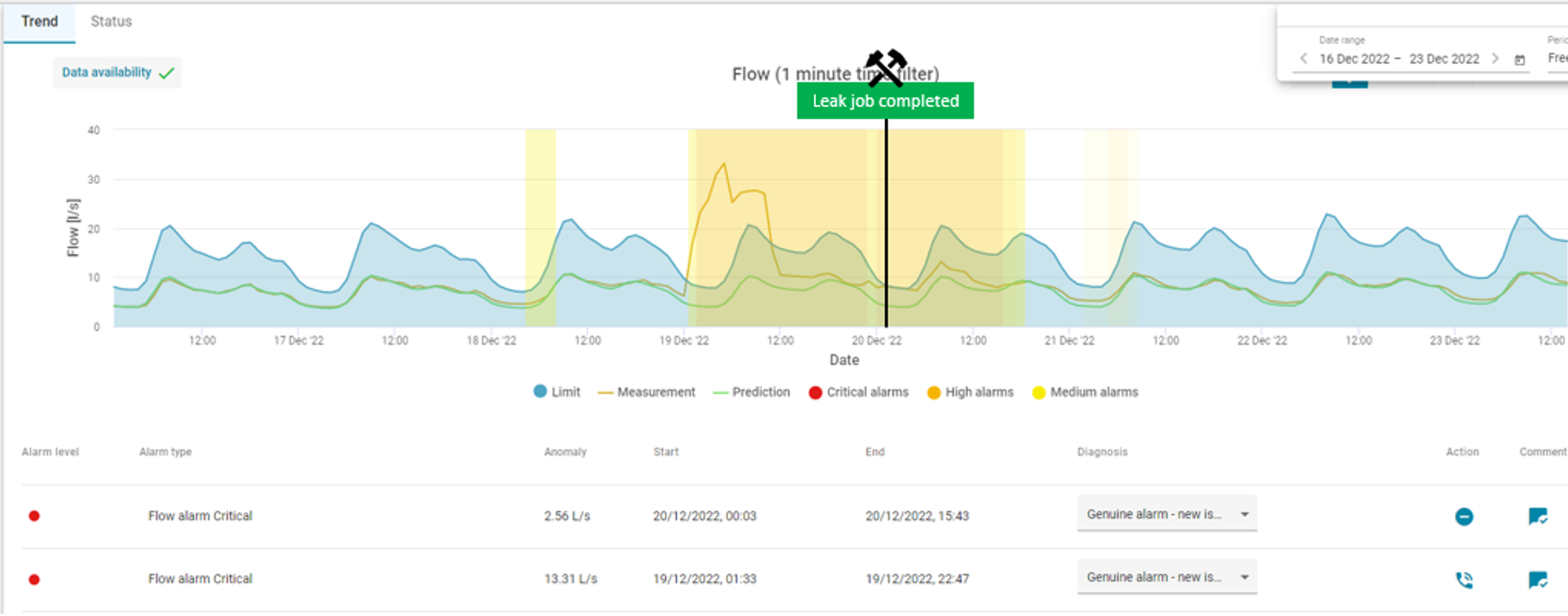
Figures 3 and 4 show examples of alarms due to consumption anomalies – and their respective leak jobs. These illustrations demonstrate how the alarms are generated once flow increases outside of normal conditions and how, after leaks are fixed, flow conditions revert to expected levels.
Using the alarms in Aquasuite, SES Water could plan leak searches and fix issues quickly. Without Twinn, these variations would have taken longer to identify.
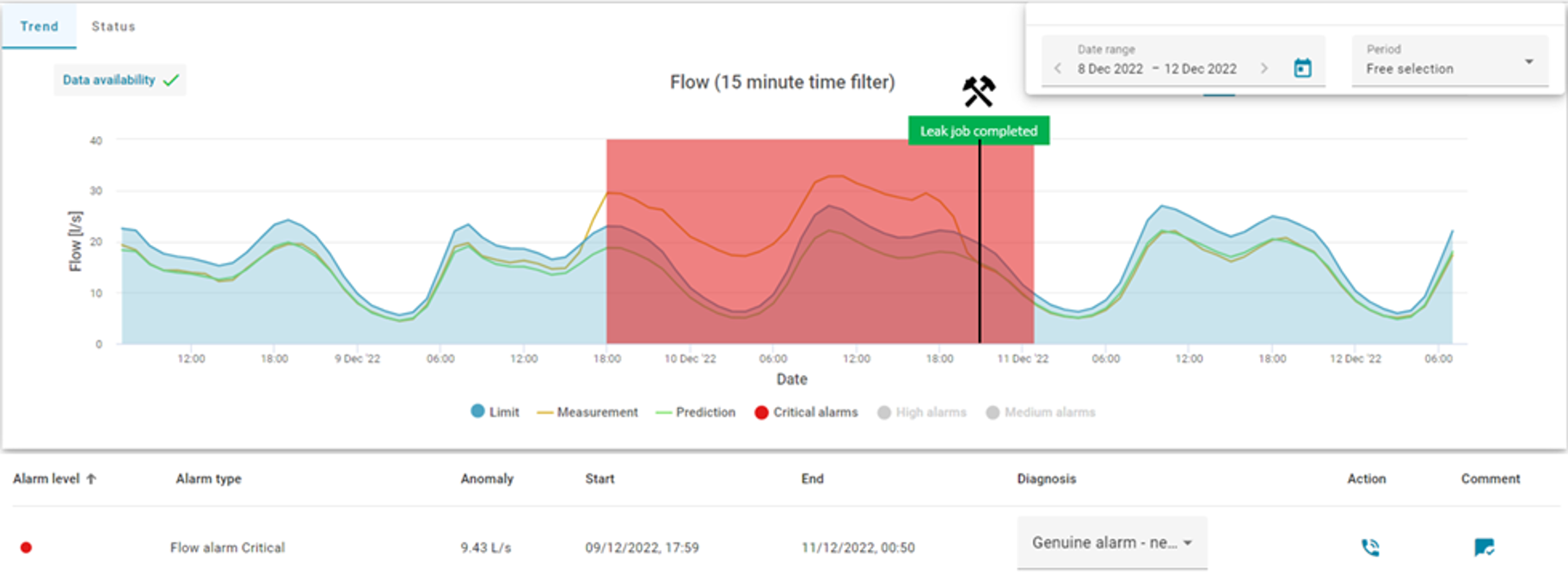
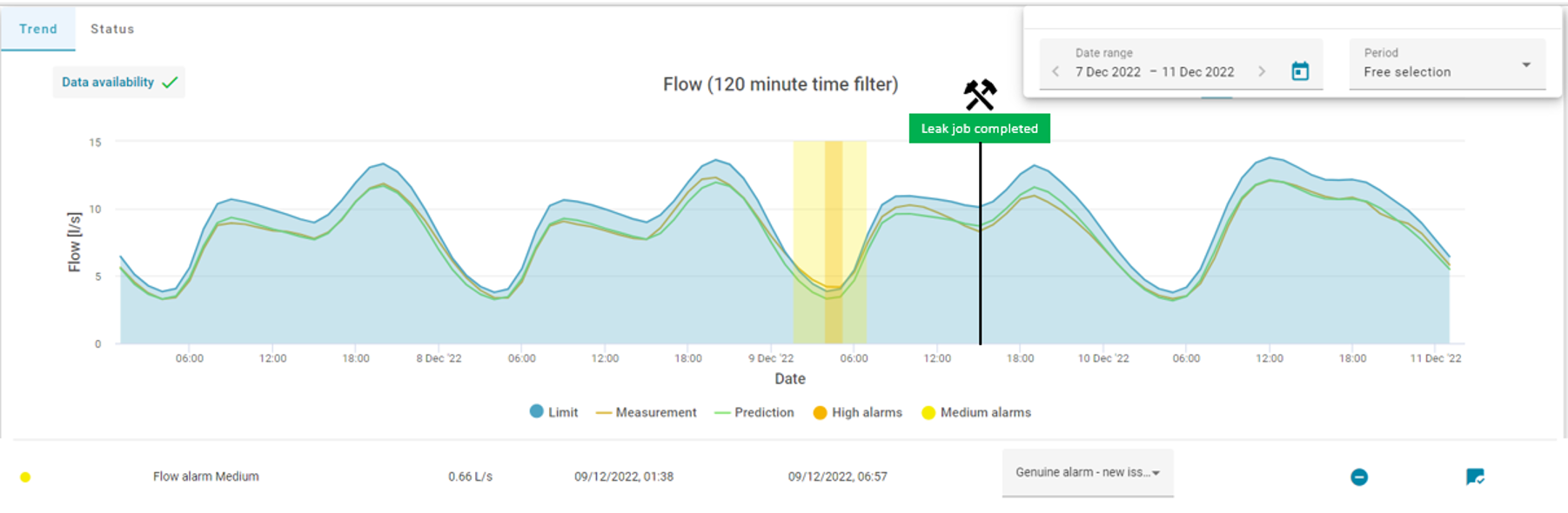
Sian Evans, Asset Intelligence Lead at SES Water, said: “Aquasuite sends us alarms and quantifies the size of the issue. Because of that, we were able to identify the bursts with the most significant impact to our customers quickly – and minimise interruption to supply. We were really impressed at how the platform performed during this time. For example, the leakage of 13 l/s – the biggest we had during this period – was prioritised, as we could see its size in the platform.”
As climate change shifts weather patterns and increases the frequency of unpredictable events, operational teams need to adapt. Aquasuite is a powerful tool for identifying anomalies, water consumption patterns and potential leakages, saving time and effort for operators and enabling analysts to focus on strategic planning and continuous improvement.
Leveraging the learnings from December 2022, SES Water is better prepared for subsequent winters. “The number of Aquasuite alarms will be an incident trigger level in our winter event plan going forward, which will inform our operational response,” Sian concluded.
Using AI to reduce leakage

Want to learn more about digital solutions for the water sector?
Contact our Water Technology experts