Is there a Climate risk framework? Key questions answered
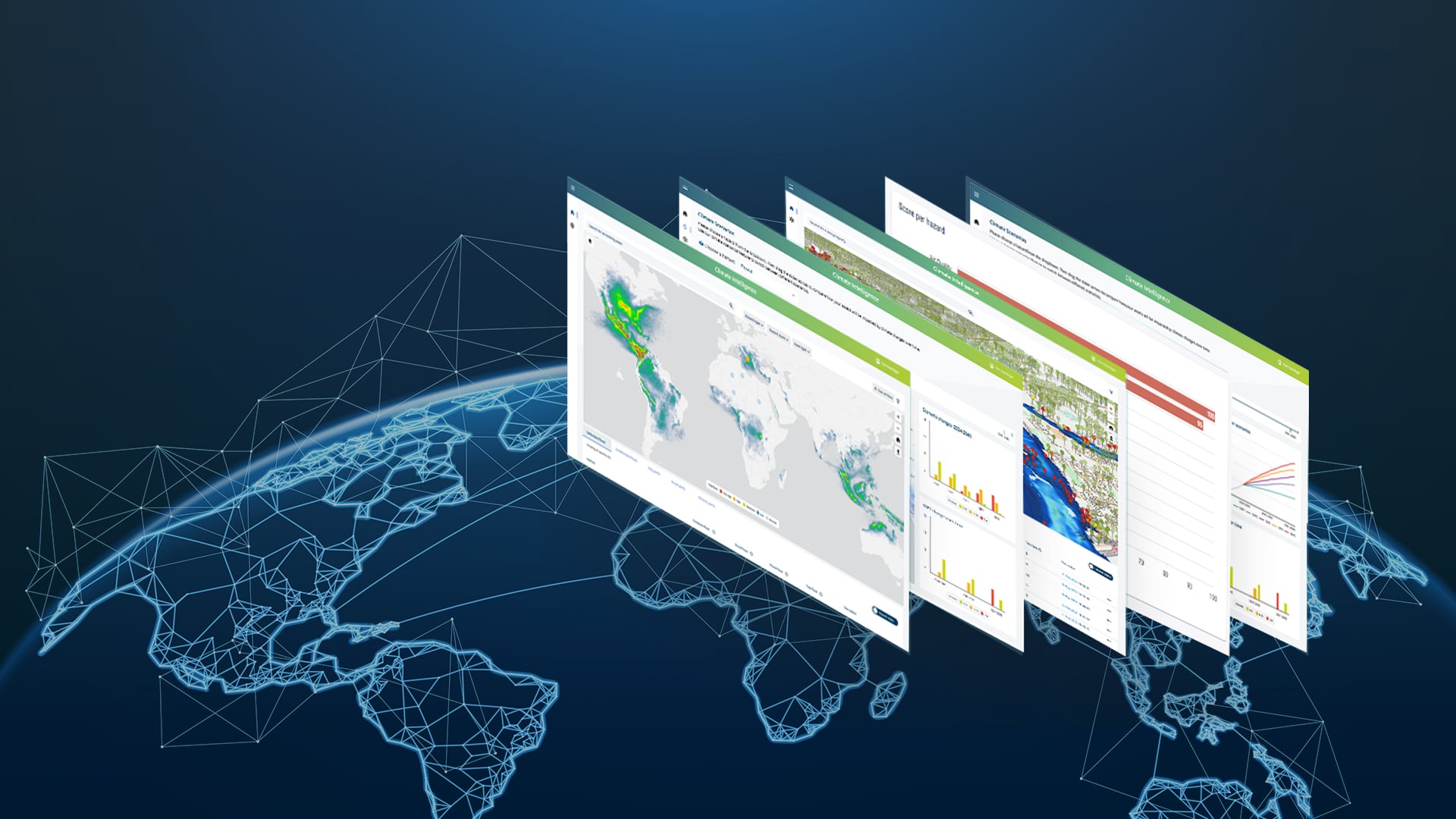
But what is climate risk intelligence? And how does it help you become resilient and sustainable? In this article, our experts answer the questions we’re asked most often.
Put simply, climate risk intelligence is the insight that enables us to understand climate risk and take action to mitigate it. Organisations need to understand what risks they face due to climate change – and how those risks impact assets and operations, now and into the future.
When we talk about climate risk, we’re referring to both physical and transition risk:
- Physical climate risk – is the potential for damage by climate hazards (be it floods, wildfires, earthquakes or extreme weather) to assets, infrastructure, supply chains and business continuity
- Transition climate risk – is risk that arises from the transition away from fossil fuels and towards a low-carbon economy. These could relate to market, policy, litigation, reputation or technology
Of course, physical and transition risks are inextricably linked. As the physical risks associated with extreme climate events increase, so do the costs of both action and inaction (the transition risk). To make informed decisions about becoming climate resilient, you need to consider both physical and transition risk based on various possible climate scenarios. To do this, you need access to climate intelligence data.
There’s no single climate risk framework globally. Generally speaking, there are 2 categories:
- External frameworks (from regulatory bodies, for example)
- Frameworks that are created and driven internally
Depending on your sector, organisations can align with various regulatory and best-practice frameworks. These include
- Task Force on Climate-Related Financial Disclosures (TCFD) – created by the Financial Stability Board, TCFD provides recommendations on climate risk disclosures companies should make to investors, lenders and underwriters
- Global Reporting Initiative (GRI) – GRI develops global best practice for how organisations communicate and demonstrate accountability for environmental, social and governance (ESG) factors
- Central banks – the ECB regulates European financial service organisations on managing climate risk; the Bank of England does the same for UK-based entities (Read more here)
- Industry bodies – for instance, the UK Law Society has issued guidance for lawyers and conveyancers on disclosing climate risk
Now, let’s discuss internal climate risk frameworks
Many organisations develop their own frameworks around what they want to achieve from a climate perspective. These could be based on strategic drivers like net zero targets or ESG considerations.Climate scores quantify the change in climate risk across future scenarios and time periods (known as epochs). Encompassing a range of hazards – from flooding to wildfire and heatwaves – it’s a way to understand the physical risks the organisation faces.
Climate risk scoring enables you to:
- Understand risk today – and the likely impact that a climate event occurring now would have on your operations/resilience
- Fast forward into the future – looking at different epochs (including the 2050s, the 2080s and beyond) under different emissions scenarios
- Factor in Relative Concentration Pathways (RCPs) – which consider how much carbon is in the atmosphere and how much warming that creates
- Understand how the risk profile changes – as a result of climate change for any asset, anywhere in the world
Risk scores can be standalone or aggregated. Depending on your use case, you can look at risk from an individual hazard perspective (flood, drought or wildfire, for example) – and you can aggregate that to classifications, such as hydrological, meteorological and geological.
You can also get climate risk scores for individual assets and aggregated across your portfolio. So you can understand:
- The climate risks specific to property A, B and C
- The risk to a wider geographical area, e.g. a postcode
- Based on future climate risks, which city you should invest in – or which country
It’s not just about accessing the highest-resolution data for each hazard. You also need to apply a standardised risk rating methodology to get a consistent view of risk across hazards and locations.
We leverage depth damage curves to turn hazard layers into scores and ratings. We cover everything within one platform or data feed based on the best-available data – and convert it into consistent risk ratings on a scale of 0-100.
As a result, you get actionable insights:
- Starting at property/asset level, we enable you to aggregate at any degree – this gives you granular data that’s more useful when it comes to mitigation activity
- We give you a score/index as well as the underlying data – as a made-up example, a wind score of 50 means a 1-in-100 windstorm event will have a wind speed of 70 mph
- Our methodology uses the latest climate science, which was recently updated from CMIP 5 to CMIP 6 – by leveraging a global aggregated climate model view, your risk scores reflect the latest thinking in climate scenarios
Depending on the level of detail you need, we can also offer a simplified traffic light system for risk scoring, making it easy to compare different assets and locations. The 0-100 risk ratings are classified based on thresholds and severities, and can be utilised to define your risk appetite/strategy. That way, you get an appropriate representation of risk level.
Watch this short video to discover the benefits of Twinn hazard risk data and risk scoring.
Risk and exposure are separate things:
- Exposure – refers to an individual, business or company’s susceptibility to various losses or risks. For example, the extent to which your asset (house, factory or supply chain, for example) is exposed to a hazard.
- Risk – is the likelihood of harm/damage occurring as a result of that hazard
To calculate climate risk, our methodology (outlined above) combines high-resolution hazard data with machine learning, climate exposure analysis and risk scoring systems.
Physical risk modelling is crucial to our methodology – we create models that account for different attributes for different hazards. We correlate those to your assets by looking at vulnerability, which is how exposed the particular asset is to the hazard.
At a basic level, the risk is then calculated as:
Risk = Hazard * Vulnerability
Depending on your requirements, you can get the results down to a granular level of detail or get an averaged view. You can then use the intelligence to answer a wide range of questions with confidence. For example:
| Banks | Insurance | Industry | Other markets |
|---|---|---|---|
| If we offer mortgages at a particular rate, do we have adequate capital in reserves to deal with a depreciation in property value? (Mortgage lender example here) | What is the potential average annual loss and annual damage ratio? How much damage is expected at this property now or into the future? (Insurer examples here) | Are our 10 factories worldwide at risk of flooding? Does that change in 10 years when the lease runs out? (Infrastructure example here) | Are our assets prone to risk today? To what degree does that risk change over time? (Telecoms example here) |
We model 19 major climate hazards – ranging from coastal, fluvial and pluvial flooding to tropical storms, drought, earthquakes and hail. However, not all of them will be relevant depending on where your assets are located, the framework you’re reporting into and what you’re trying to achieve internally.
Start with geographical location, removing hazards that don’t impact you and identifying those most relevant to your portfolio. From there, you can further refine based on your operations and requirements.
Once you’ve conducted the assessment and understand the risk scores, you can implement solutions that enable ongoing monitoring. These early warning systems generally involve sensors, alerts, gauges and live data plug-ins. For example, you’ll be alerted to the need for additional flood defence because a river level reaches a certain threshold. Or you’ll get a temperature alert that signals the need to implement machine downtime to avoid overheating.
When you have the data and monitoring capabilities, you can work proactively to mitigate the effects of relevant hazards. And that’s how you ensure ongoing climate resilience.
You need to root your analyses in the latest climate science. Depending on your use case and what you’re trying to achieve, you should consider:
- Set climate scenarios known as Relative Concentration Pathways (RCPs) – the core ones are 2.6, 4.5, 6.0 and 8.5
- Socio-scientific issues (SSIs)
If you’re conducting a stress test, you might want to pick the worst-case scenario – one in which we keep pumping ever-higher levels of CO2 into the atmosphere – even though it’s unlikely. At the other end of the scale, the best case involves ceasing CO2 emissions now, which again is unlikely. A conservative view would take the middle group, which is RCP 4.5 or 6.0.
By integrating climate risk scenarios into stress tests, you’ll understand your resilience to climate events – and develop the right mitigation strategies to protect your assets and investments.
We advocate a bottom-up approach where you start at the hazard level. Using data and the latest climate science to understand the hazards, you’re better equipped to define the risks.
Then, consider a couple of categories of climate risk:
- Direct climate risks – the impact on your fixed assets (your factories, offices, fleet, mortgage policies, addresses of policyholders, for example)
- Indirect risks – that impact your supply chains. For industrial sectors, this could be the risks to a mine that supplies raw material or an airport terminal that goods travel through; for financial services organisations, it could be risks to the industries it’s reinvesting in
Watch this video to learn how to get help to find out how climate change could be disrupting your business, where and how?
There are numerous tools available. When selecting a partner, your first decision is probably whether you want to take a bottom-up or a top-down approach. (As discussed above, Twinn starts at the bottom with hazards, which enables us to better understand risk.) It’s also important to consider whether you want all your data in one place or whether you want to use different providers for different elements.
Recently, we’ve seen a real market drive for providers able to cover every element of climate risk intelligence. Why do clients choose Twinn as their climate risk intelligence provider?
- Multi-hazard modelling techniques – our datasets cover 19 hazards
- Software, data and domain expertise – backed by 140 years of engineering expertise from Haskoning plus 25 years of proprietary climate intelligence IP from Ambiental (now part of Twinn)
- Our commitment to leveraging the latest climate science – plus the consistency of our global approach
- Sector-specific regulatory connections – we’re a member of TCFD, for example
- Our single platform – simplifies the workflow and reporting
- Overarching flexibility – access climate risk intelligence via our cloud-based app or plug our data into your systems via flat file or API
- In-house skills analysis – depending on your internal capabilities, you can use or data and analyse it yourself or use our experts to provide analysis
- Tried-and-tested approach – encompassing internal validation and verification; we’re a recognised leader whose climate risk data is regularly featured in annual reporting
Loading...
Climate Intelligence Risk Products
Watch this short video to discover why customers choose Twinn hazard risk data?
Take the first steps in making your business resilient to climate change.
Do you have more questions about climate risk intelligence?
Get in touch with our climate risk intelligence experts.