How we tackle climate change with a digital twin
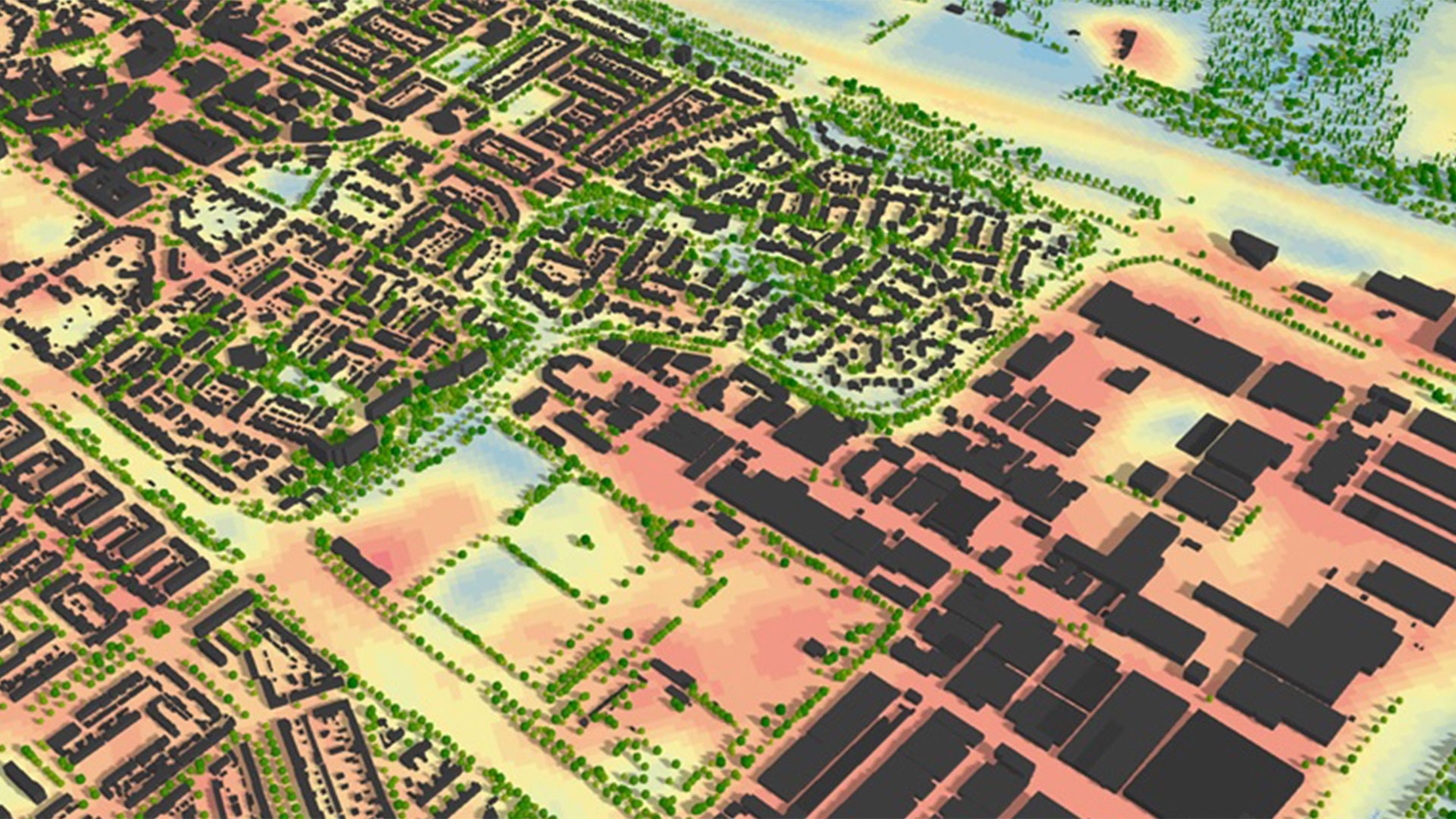
The municipality of Best in the Netherlands is just one of many regions currently exploring ways to tackle this universal challenge – and it came to RHDHV in search of answers.
Project facts
- Client
- Municipality of Best
- Location
- Netherlands
- Date
- 2021
- Challenge
- Identify areas most susceptible to heat risk in the municipality of Best, and implement solutions to remedy them.
- Solution
- RHDHV used a 3D digital twin to identify the areas of Best most susceptible to heat risk. It then used simulations to test, validate and optimise approaches to help mitigate the effects. Gijs van Lith, Koen Peters, Ronald Groen, Simon Schoonen
The challenge
Rising temperatures and growing concern
With roughly 30,000 inhabitants, Best is a lively community close to the city of Eindhoven. The municipality is part of the Brainport region, known as ‘the high-tech engine of the Netherlands’, where innovative technologies are developed to help ensure a brighter future for everyone.As in many other areas of the world, climate change is a growing concern for the inhabitants of Best. The region’s policymakers are dedicated to combating rising temperatures and ensuring a high quality of life for citizens – both today and tomorrow.
However, they know that to make the most effective decisions in this area, they need the best insights. Which is why they turned to RHDHV for advice.
The solution
Introducing Heat Monitor
RHDHV was initially onboarded to help identify and tackle areas in Best where people may be susceptible to heat stress.
Heat stress occurs when the human body cannot expel excess heat, causing its core temperature to rise and heart rate to increase. If left unchecked, it can be extremely dangerous – even deadly.
At the heart of our solution is Heat Monitor, a 3D digital twin that helps aid decision making by providing accurate, timely data in easy to interpret visualisations.
Heat Monitor is able to identify, list and order the neighbourhoods, areas and buildings in Best where heat risk is most imminent. And, importantly, it is able to pinpoint the factors that contributed to that risk – enabling our consultants to devise a plan of action.
The digital twin also allowed allows Best to test the effectiveness of various plans of action using a UCAM method. UCAM is a state-of-the-art heat stress model created in a collaboration between Wageningen University, the Royal Netherlands Institute, Witteveen+Bos, and our colleague Ronald Groen.
Using these tools, our consultants were able to implement a repeatable four-step process in which they gathered data, built scenarios, advised on best actions, and then simulated those actions to test their impacts – all in a completely virtual environment.
The result
A truly sustainable impact
Heat Monitor plays a vital role in the municipality of Best’s war against rising temperatures, delivering greater insights into problem areas and providing proven roadmaps for optimal mitigation.
In one instance, Best had plans to plant trees in areas that were most prone to heat risk, with the intent of creating more shade. Using Heat Monitor, RHDHV was able to simulate the potential impact of those plans and adjust them to reach optimal effectiveness.
The result is greatly reduced heat stress in the areas of the De Willem and De Zwijger apartment blocks – and a substantial improvement in quality of life for their inhabitants.
The Heat Monitor really helped us see where our citizens have the most risk of heat stress, and the different options we have to lower these risks.
Results

Do you want to know moreor have a question?
Contact our experts!