Webinar Q&A: Top questions on predictive simulation for offshore wind
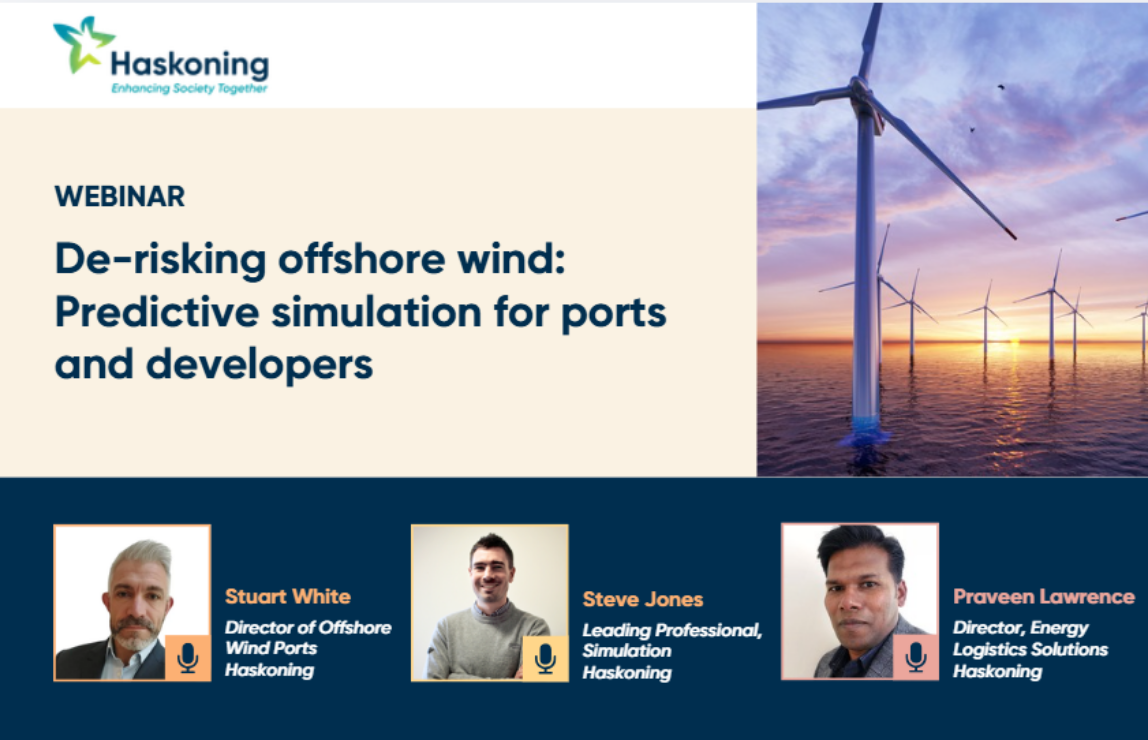
Our recent webinar, De‑Risking Offshore Wind: Predictive Simulation for Ports and Developers, brought together nearly 100 participants across the offshore wind ecosystem, including developers, port authorities, consultants, government agencies, and more. The Q&A session sparked thoughtful, practical questions. Below we’ve compiled the top questions and expert answers.
How can simulation help developers de‑risk projects at early development stages?
Even with low data maturity early in a project, simulation can play a significant role. Developers often face many unknowns and multiple possible strategies. Using a simulation tool such as Haskoning's Witness simulation software, teams can test these options long before investing money, time, or resources.
By modelling early ‘what‑if’ scenarios, developers can identify likely bottlenecks, understand sensitivity to weather or vessel availability, and compare strategies to reduce uncertainty.
Early‑stage simulation supports decision‑making even when detailed project data is not yet available.
How do ports balance supporting multiple sectors, such as offshore wind and defence?
Ports are adaptive commercial environments. While some terminals (e.g., container terminals) are more specialised, offshore wind facilities generally consist of heavy‑industrial zones with flexible layouts, making them easier to repurpose for adjacent sectors like defence logistics.
Balancing different industries can actually strengthen a port’s business case, especially when offshore wind project pipelines fluctuate. Simulation also helps ports model traffic interactions, berth utilisation, and channel access to ensure multi‑sector operations run smoothly.
How is weather modelled to ensure fair comparison across scenarios?
Weather variability is one of the greatest operational risks in offshore wind. To ensure fairness, all scenarios in Witness are run using identical random number streams — meaning replication 1 in Scenario A experiences the same weather pattern as replication 1 in Scenario B.
This apples‑to‑apples methodology eliminates scenario bias. Each scenario is then run 50+ times to capture the range of best‑case and worst‑case results. All runs are fully repeatable, which is essential for project assurance and stakeholder review.
Missed the webinar?
What role do digital twins play in offshore wind operations?
Digital twins mirror real‑time operational conditions, but without simulation, they cannot forecast future states or evaluate alternative decisions. Simulation provides the predictive intelligence—forecasting utilisation, logistics interactions, maintenance windows, or weather‑driven downtime. When embedded into a digital twin, simulation transforms it from a monitoring tool into a decision‑support engine.What role can digital twins play in future offshore wind asset management?
Digital twins are expected to play an increasingly important role in cost‑efficient offshore wind asset management. By combining real‑time operational data with predictive simulation, digital twins can help operators forecast maintenance needs, understand how weather or equipment performance will influence availability, and test operational decisions before implementing them. As offshore wind assets grow in number and complexity, especially in floating wind, this kind of predictive, data‑driven insight will become essential for optimising performance and reducing lifecycle costs.What level of data maturity is required for meaningful simulation?
Strategic‑level simulation does not require deeply detailed datasets such as bathymetry or precise quayside geometry. High‑level assumptions about port capability, component sizes, timelines, vessel needs, and weather conditions are sufficient to explore supply‑chain feasibility and port strategy. Detail can be added progressively as projects mature or decisions require greater fidelity.How do you validate simulation models against real operational data?
We validate our simulation models by comparing their outputs with real operational data once a project is completed. For established offshore wind and port processes, there’s already a strong record of actual project durations and performance metrics, so it’s more straightforward to check how closely the model’s predictions align with real world results.For newer technologies, like floating wind, the validation process is more challenging. There is less historical data to compare against, so we rely on the best available benchmarks, engineering assumptions, and expert knowledge. As more floating wind projects are built, we can incorporate those results to continually refine and improve the models.