Monumental and modern: renovation of Binnenhof, The Hague
Project facts
- Client
- Central Government Real Estate Agency
- Location
- The Hague
- Date
- 2017-2031
- Challenge
- Installation and fire safety renovation of the Senate and Council of State buildings (10,000 m²) so they meet current and future requirements, while preserving their monumental character.
- Solution
- Integral design with innovative solutions that make these buildings a safe, fireproof, comfortable and energy-efficient (working) environment that can be properly maintained.
Complex organisation
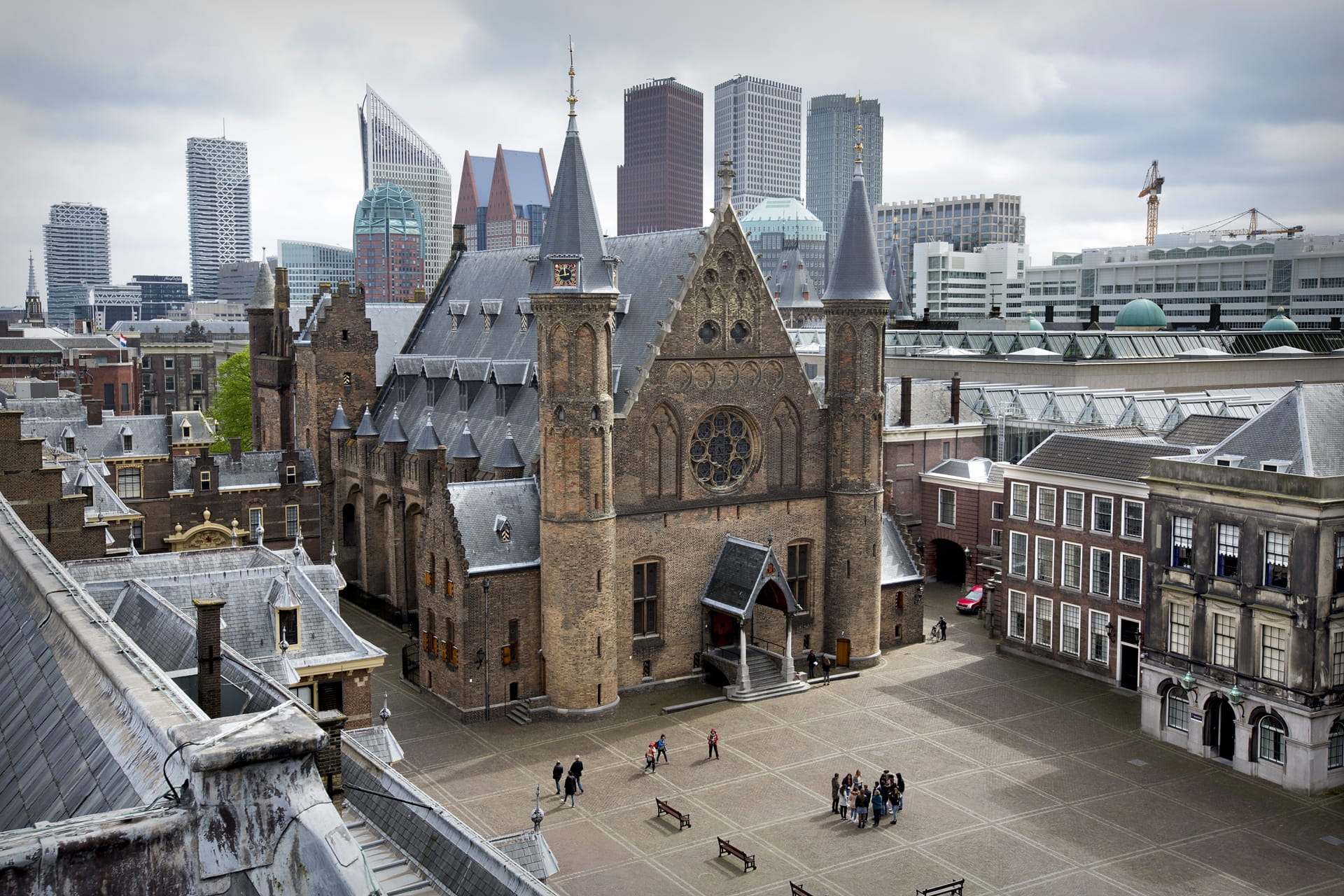
For centuries, the Binnenhof, which consists of several monumental buildings built between the 13th and 20th centuries, has fulfilled various functions. Now the Binnenhof is being adapted to meet modern requirements. Commissioned by the Central Government Real Estate Agency, we are putting our design and engineering expertise to work on part of this renovation: the Senate and Council of State buildings.
Outdated building sections, missing or outmoded installations and insufficient fire safety made the renovation of the complex necessary as it no longer met statutory requirements. However, because the building sections were continuously in use, interim renovation was previously not possible. Its role as a visitor attraction, combined with the daily activity of politicians, makes the renovation a complex, multi-year operation that requires constant coordination among numerous of design parties and stakeholders such as users, the Central Government Real Estate Agency, contractors and municipalities.
Haskoning is responsible for the installation technology and fire safety and for the assurance thereof in the integral design. We are also responsible for validation and quality assurance up to and including delivery.
Drawing on multidisciplinary expertise, we have ensured a sustainable future for the Binnenhof’s monumental buildings, in line with today’s high standards.
Mapping dependencies
Consultancy work started in 2017, with Haskoning making a substantial contribution in respect of installations and fire safety. In the absence of up-to-date, complete construction drawings, the Central Government Real Estate Agency commissioned a 3D scan of the building complex to enable work to be carried out based on a BIM model. In the initial phase, thematic workshops were held to establish what was important to stakeholders. We translated the Conceptual Design into a Preliminary Design, Detailed Design and Technical Design by means of collaboration with design partners, by advising on subjects such as spatial requirements, materialisation, product choices and specific dimensions. The design process, which is carried out in phases from coarse to fine, is organised allowing all parties to understand each other's dependencies and continue to make adjustments. With this, the main challenge was integrating modern technical installations into a monumental building originally designed for natural ventilation while ensuring the building becomes energy-efficient, sustainable and comfortable.Safety first
One of the important points for attention is the safety of users and visitors. Safety requirements have become stricter worldwide, requiring new solutions to be devised along the way. For instance, we worked with the security department and looked at how to deal with visitor flows. This resulted, among other things, in a new design for the public entrance to the House of Representatives.
Fire safety is a priority. Previously, the Binnenhof lacked sufficient reliability due to architectural and technical deficiencies, the aim is to deliver a complex that remains visually monumental while offering modern facilities and meets the highest standards by 2031. This presents challenges such as: how do you preserve aesthetically valuable but impractical monumental elements when installing modern systems? We inspected the current installations and structural fire separations, compared different concepts, identified the impact of specific material choices on other disciplines and acted as a sparring partner for the design partners and contractor when finalising the Technical Design.
Ventilation: bringing the Binnenhof into the 21st century
Ventilation plays a significant role in making buildings more sustainable. The Binnenhof, which is used on a daily basis as meeting and office space and attracts thousands of visitors from home and abroad every year, had no mechanical ventilation. Where do you place central air handling units, heat pump systems and large air ducts and pipes in a building over100 years old where many monumental details such as ornamental ceilings and layouts need to be maintained? In the first phase, the location of workrooms and technical rooms was determined, but later it turned out that these plans had to be changed.
When the Binnenhof staff moved into their temporary accommodation in 2022, a lot of new information about the complex came to light. Archaeologists discovered finds in places where the floor had been removed. It was also found that some walls were solid and several metres thick, leaving no room for ventilation ducts. The design has been constantly refined in order to ensure that the buildings will ultimately be future-proof. Solutions had to be sought within the constraints of the existing walls, often specifically per room. We explored creative solutions with the monumental architect, building physics consultant and building cost consultant to questions such as: how can you hide heating and cooling pipes from view? What is the best place for power points, cabling, air ducts, lighting and data? And how is back-up arranged for heat and power?
As a multidisciplinary engineering firm, we are also involved in many other elements of the project, such as reinstating an old part of the moat around the Binnenhof that was filled in. For this, we advised on water quality and quay walls, for example. We are closely involved in advising the Central Government Real Estate Agency on nitrogen and obtaining the necessary permits for this, which has made the renovation of the Binnenhof possible.
Would you like to discover how to create a future-proof building that aligns with your ambitions?