Developing public and tourist transport services in Georgia

Project facts
- Client
- LEPL Tbilisi Development Fund
- Location
- Georgia
- Date
- 2020 - 2021
- Challenge
- Urban congestion and untapped river potential demand sustainable transport and tourism options.
- Solution
- A strategic plan for water transport with routes, vessels, and infrastructure for safe navigation.
River transport
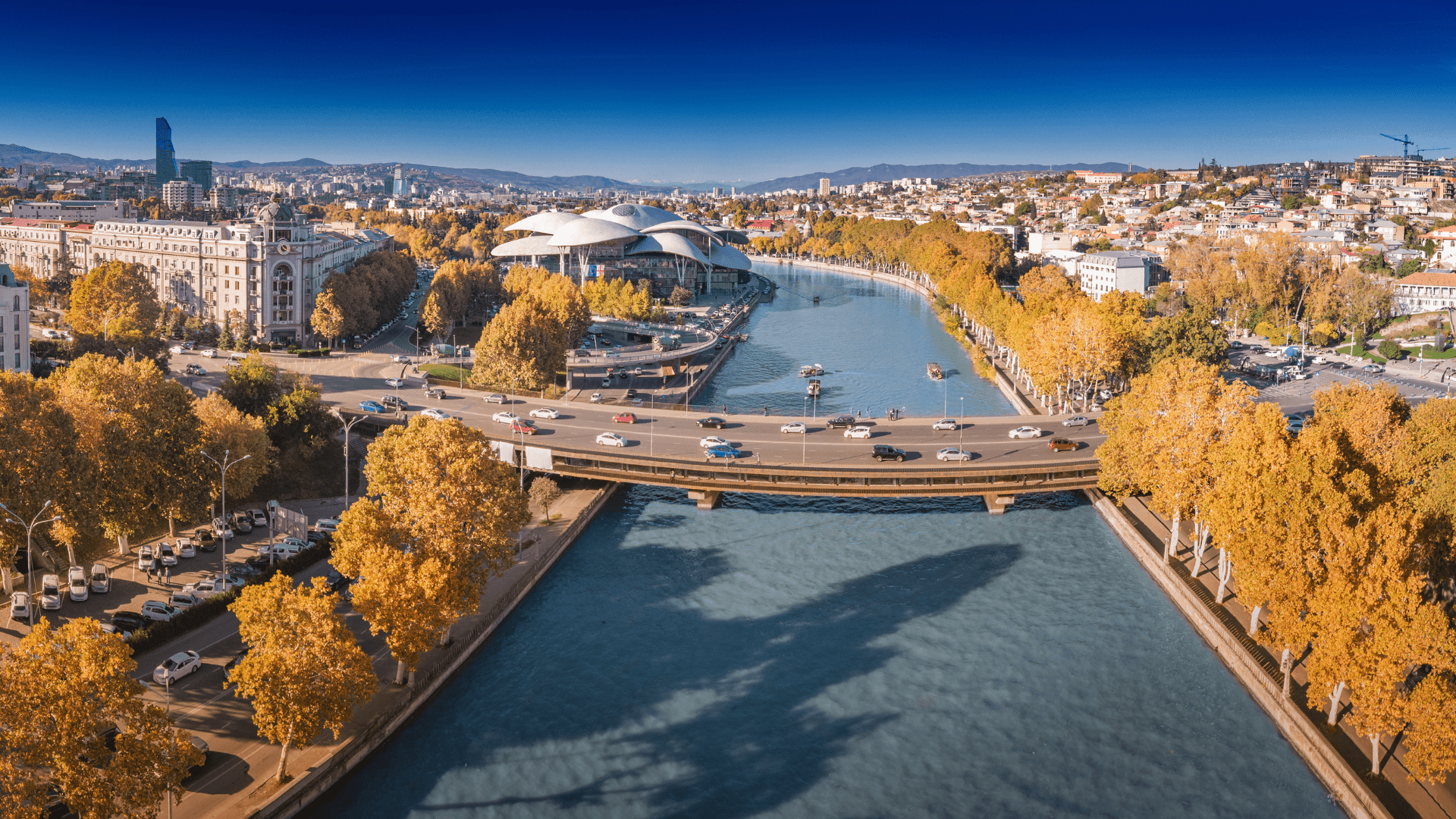
Urban mobility in Tbilisi faces congestion, environmental concerns, and limited sustainable transport options. At the same time, the tourism potential of the Mtkvari River remains largely untapped.
We were engaged to assess whether the river could serve as a viable transport corridor for both commuters and tourists, while ensuring safety, environmental sustainability, and economic feasibility.
Comprehensive feasibility study
Our study delivered a comprehensive analysis and strategic plan, including:
- Development of a vision and public transport strategy for river-based mobility.
- Assessment of current and future performance scenarios.
- Estimation of ridership potential for commuter and tourist services.
- Identification of navigable routes within the Ortachala–Zahesi section.
- Selection of suitable vessel types and technical parameters for safe navigation.
- Determination of infrastructure requirements (quays, piers, passenger access, commercial facilities) with preliminary cost estimates.
- Economic and financial analysis of proposed services.
Unlocking the Mtkvari river’s potential
Our study identified the significant potential for the Mtkvari river to be used as a key transport and tourism artery. As well as reducing road congestion, noise, and pollution, using the river for transport could enhance economic development through tourism and improved urban mobility.
Its use will contribute to efforts to create a more sustainable and attractive urban environment.
The feasibility study indicates that a new river transport service on the Mtkvari could, depending on the final route and service pattern, attract between 7,500 and 15,500 passengers per day made up of both commuters and visitors. The strongest potential is on the Ortachala–Tamar Bridge section, where demand, navigability, and scalability are highest.
By providing a competitive alternative for cross river and riverside trips, the service could replace a proportion of car journeys, particularly for commuters and tourists currently using congested road corridors. While the exact reduction in car trips will be confirmed in the next phase, the study shows that river transport could meaningfully shift trips away from roads in areas directly along the river.
If delivered using electric or other low emission vessels, the service could contribute to lower transport emissions, improved air quality, and reduced noise along the river corridor. Clean vessel technologies are already technically feasible for the proposed routes, with zero local emissions when fully electric boats are used.
Where expertise meets impact

Data - driven decision making

Stakeholder - centric approach

Strategic & integrated
Haskoning’s work has demonstrated the exciting potential of the Mtkvari River. Their detailed study has identified new opportunities and confirmed the feasibility of achieving a more sustainable transport system which will support economic growth and tourism.

Mobilityenquiries
Contact our Mobility experts
Mobility