Wave overtopping modelling in UK coastal engineering

KemingHu
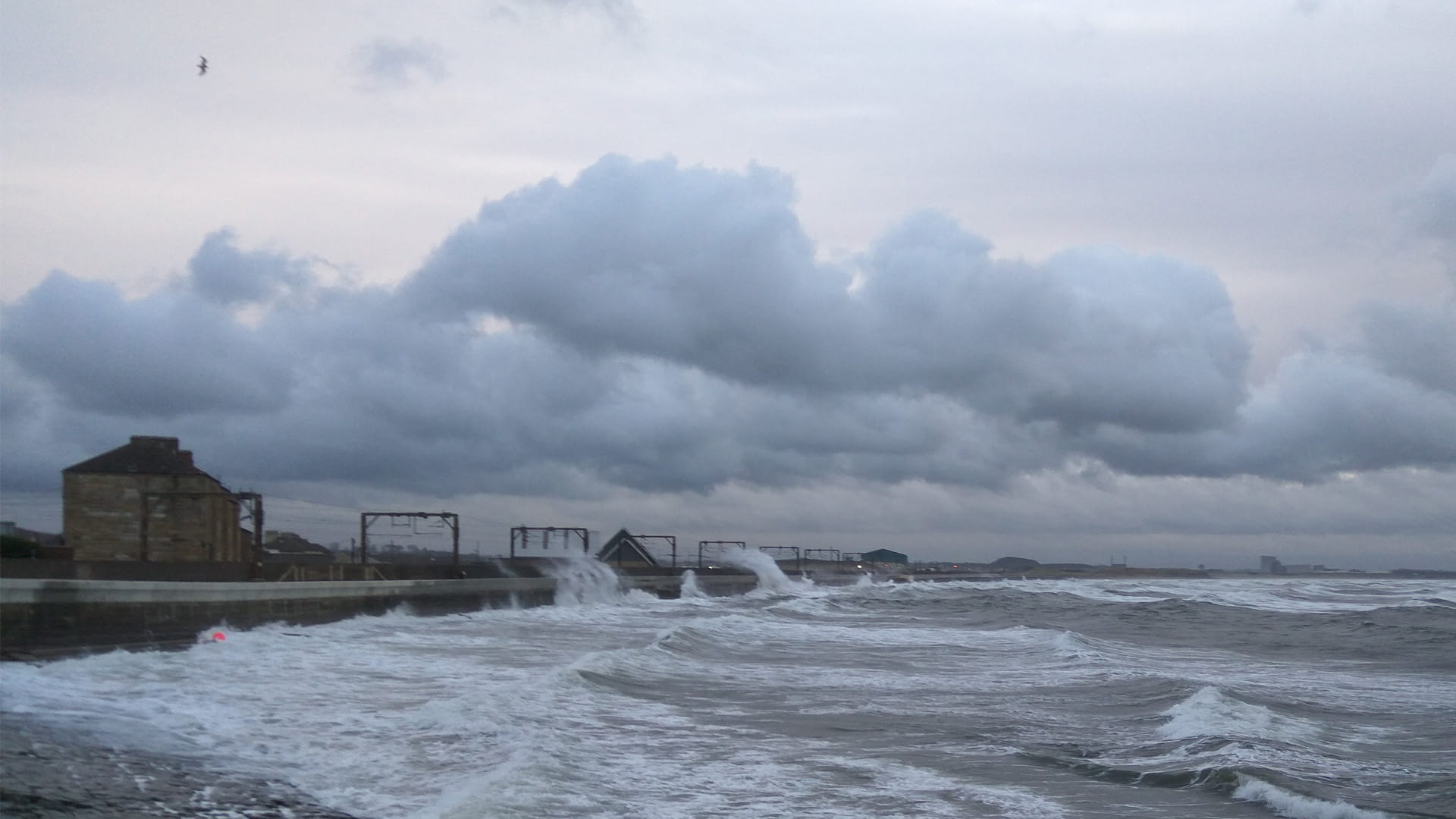
Wave overtopping continues to play a central role in UK coastal flood risk assessments. While many coastal defences are designed to prevent still-water exceedance, the majority of significant flooding events along developed coastlines arise instead from waves overtopping the structures that protect them. This overtopping can be highly variable and difficult to predict, with a handful of large, energetic waves often responsible for the majority of overtopped volume during a storm. Even small mean discharge rates can accumulate behind a defence if drainage is limited or if the hinterland is low-lying. As a result, accurate modelling of overtopping is essential for informing defence design, planning submissions, and flood risk management.
The Environment Agency’s Coastal Flood Modelling Guidance, published in April 2022 and widely adopted across industry in the following years, provides clarity on how overtopping should be approached at different stages of assessment. Although the guidance is no longer new, it remains the authoritative reference for consultants, regulators, and local authorities. Its influence has grown steadily as planning authorities and the EA continue to scrutinise modelling approaches more closely. For wave overtopping, the guidance identifies specific approved methods and sets out expectations that now form the basis for accepted practice in UK coastal engineering.
This article provides a technically grounded overview of overtopping processes, explains how the EA guidance frames acceptable modelling tools, and offers a comparative discussion of EurOtop, AMAZON, and CFD approaches. The aim is to support practitioners in selecting methods that align with both regulatory expectations and the physical characteristics of their sites.
Understanding wave overtopping
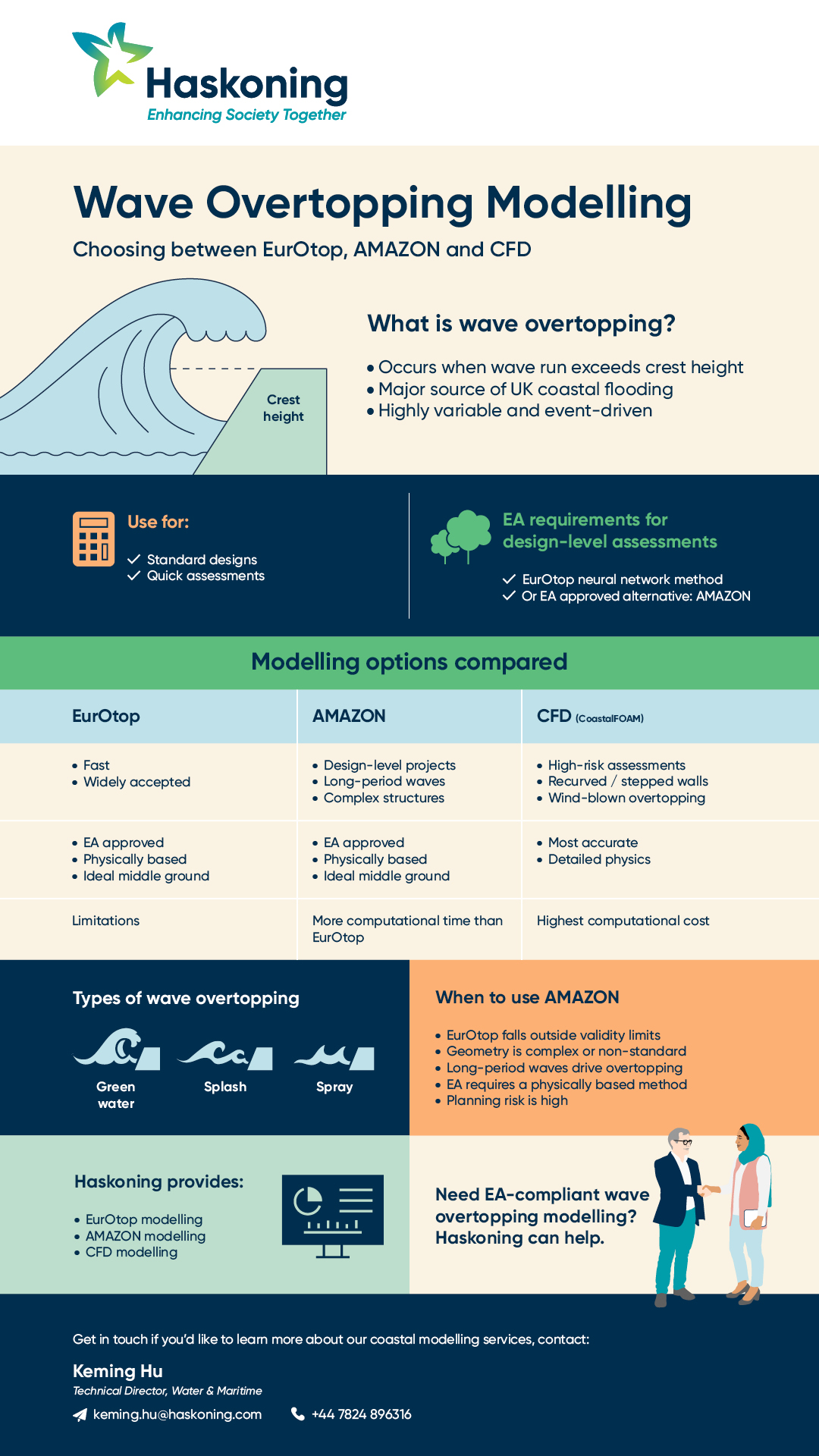
Wave overtopping occurs when incident wave run-up extends above the crest of a coastal defence. Although the concept is straightforward, overtopping reflects a combination of complex hydrodynamic processes including wave transformation, breaking, momentum transfer, turbulence, and interactions with local geometry. The resulting overtopping volumes are sensitive to a host of factors such as wave height and period, storm surge conditions, the shape and slope of the structure, surface roughness, and wave direction.
The nature of overtopping varies in form. “Green water” events involve a coherent mass of water crossing the crest, usually under energetic conditions or on sloping structures. “Splash” overtopping results from jets or droplets thrown over the crest after wave impact. “Spray” overtopping, enhanced by wind, typically comprises fine droplets that may not contribute significantly to flood volume but can affect operational conditions and asset exposure. This diversity underscores the need to choose a modelling approach capable of representing the relevant processes for each site.
Overtopping is not uniform over time. It often occurs as a sequence of moderate events interspersed with infrequent, much larger peaks. These peaks can have disproportionate influence on flood pathways and hazard potential. A reliable modelling method must therefore not only estimate mean discharge rates but also represent, where necessary, wave-by-wave variability or the conditions under which extreme volumes occur.
EA requirements for overtopping modelling
The EA guidance distinguishes between strategic, appraisal, and design levels of assessment. At the strategic level, simplified methodologies may be acceptable provided the rationale and limitations are clearly presented. Appraisal-level studies offer more flexibility but require evidence that the chosen approach is appropriate for the risk and decision context.
For design-level assessments, the EA sets explicit requirements. When overtopping calculations form part of detailed design, regulatory submissions, or planning applications, the guidance is mandatory. The EA specifies two modelling approaches as acceptable for overtopping prediction:
- The EurOtop neural network method, long considered the standard in many coastal projects; and
- AMAZON, identified as an approved alternative method, based on solving the nonlinear shallow water equations.
These tools constitute the primary accepted approaches for design-level overtopping assessments. Other methods may be considered but require prior agreement with the EA and justification that they provide results of equal or greater reliability. This structure ensures consistency across projects while accommodating the need for more advanced methods where the physical processes demand them.
Although the guidance dates from 2022, its relevance has continued to increase as enforcement has strengthened. Many planning authorities now expect overtopping assessments to explicitly demonstrate compliance with these approved methodologies. This has led to greater attention to tool selection, boundary conditions, validation processes, and applicability limits.
EurOtop: A widely used empirical framework
EurOtop has been the foundation of overtopping prediction for many years, supported by the extensive CLASH database and refined neural network relationships covering a broad range of structure typologies. Its primary advantages lie in its efficiency, traceability, and ease of use in design sensitivity analyses. For many coastal structures—particularly conventional seawalls, embankments, and sloping revetments—EurOtop provides robust and defensible results when used within its stated validity limits.
However, EurOtop’s empirical nature means that it cannot readily represent all structure types or hydrodynamic conditions. It is less suited to complex geometries, highly nonlinear wave–structure interactions, or conditions dominated by long-period waves. In such cases, the outputs may not reflect the true physical behaviour of the system, and the EA guidance directs practitioners to consider alternatives.
To ensure reliable outcomes, practitioners must confirm that the site conditions fall within EurOtop’s applicability ranges and that the assumptions behind its neural network models are appropriate for the specific design context. Where this is not the case, the guidance highlights the opportunity—and often the necessity—to adopt a more physically based approach such as AMAZON.
AMAZON: A physically based, EA-approved alternative
AMAZON solves the nonlinear shallow water equations to simulate run-up and overtopping processes. This means it captures wave transformation and overtopping in a more physical manner than empirical relationships alone, while remaining computationally efficient enough for iterative design and sensitivity studies. Its inclusion as an EA-approved method provides practitioners with a valuable alternative when EurOtop is not applicable or when higher fidelity is required.
AMAZON is particularly useful in cases involving long-period waves, non-standard or composite structures, or geometries featuring berms or complex slopes. Because it produces time-varying overtopping predictions, it can offer insight into peak events that may influence downstream flood pathways or hazard assessments. Although it does not reach the full level of detail captured by CFD models, it strikes a practical balance between physical representation and computational cost.
Since the guidance was released, the industry has increasingly incorporated AMAZON into design workflows, especially in environments where overtopping behaviour cannot be adequately represented by empirical tools alone. Its position in the EA’s hierarchy of accepted methods continues to support its relevance.
AMAZON: A physically based, EA-approved alternative
AMAZON solves the nonlinear shallow water equations to simulate run-up and overtopping processes. This means it captures wave transformation and overtopping in a more physical manner than empirical relationships alone, while remaining computationally efficient enough for iterative design and sensitivity studies. Its inclusion as an EA-approved method provides practitioners with a valuable alternative when EurOtop is not applicable or when higher fidelity is required.
AMAZON is particularly useful in cases involving long-period waves, non-standard or composite structures, or geometries featuring berms or complex slopes. Because it produces time-varying overtopping predictions, it can offer insight into peak events that may influence downstream flood pathways or hazard assessments. Although it does not reach the full level of detail captured by CFD models, it strikes a practical balance between physical representation and computational cost.
Since the guidance was released, the industry has increasingly incorporated AMAZON into design workflows, especially in environments where overtopping behaviour cannot be adequately represented by empirical tools alone. Its position in the EA’s hierarchy of accepted methods continues to support its relevance.
Computational Fluid Dynamics (CFD): High-resolution insight
When overtopping behaviour must be understood in detailed physical terms—such as flow velocities, thicknesses, impact loads, or the kinematics of wave jets—computational fluid dynamics (CFD) tools provide the necessary resolution. Models such as CoastalFOAM and other free-surface CFD solvers resolve wave breaking, turbulence, splash formation, greenwater events and complex interactions with steep or vertical structures. This makes CFD suitable for cases involving recurved walls, stepped structures, harbour environments, or assets with significant safety or operational sensitivity.
CFD models can also be used to study wind-blown overtopping, where atmospheric conditions play a role in transporting droplets or spray inland. This is becoming increasingly relevant under climate projections that suggest changes in extreme wind and wave conditions around the UK.
While CFD delivers the highest level of detail, its computational cost means that it is generally reserved for situations in which empirical or shallow-water models cannot resolve key physical processes adequately. In many projects, CFD is used selectively to complement EurOtop or AMAZON rather than replace them.
Method selection under the EA guidance
Selecting the appropriate overtopping methodology involves understanding both the EA’s expectations and the physical characteristics of the site. EurOtop remains appropriate for many conventional structures, provided its applicability limits are respected. When these limits are exceeded, or when the overtopping behaviour demands a more nuanced representation of hydrodynamics, AMAZON offers a practical and EA-compliant alternative.
CFD approaches become necessary when the design question depends on detailed flow behaviour rather than mean overtopping rates. In such cases, the high resolution provided by CFD supports more robust engineering decisions.
Although the EA guidance originated in 2022, the principles behind this hierarchy remain strongly relevant. Increasing regulatory scrutiny and climate-driven changes in wave conditions continue to highlight the importance of selecting the right modelling tool for each scenario. This relevance is unlikely to diminish, and future methodologies will still build upon the physical principles that underpin the current approaches.
Positioning overtopping modelling within the broader coastal modelling framework
Overtopping modelling typically forms part of a larger modelling chain. Offshore conditions are often derived from spectral wave models such as SWAN or third-generation hindcasts. Wave transformation through the nearshore zone may require models such as SWASH or Boussinesq-type solvers. Hydrodynamic models such as MIKE or Delft3D provide boundary water levels and surge conditions. The combination of these tools, each addressing a different component of the coastal system, establishes the foundation from which overtopping predictions are derived.
The evolution of modelling technology—particularly open-source tool development and hybrid datasets—continues to expand practitioners’ options. The EA’s current guidance provides a stable framework that accommodates this evolution while ensuring consistency, traceability and technical rigour.
Conclusion
The EA’s current coastal modelling guidance provides clear direction for wave overtopping assessments in the UK. By specifying EurOtop and AMAZON as approved methods for Design-level calculations, the guidance establishes a dependable baseline for regulatory acceptance. The ongoing importance of overtopping as a primary flood mechanism ensures that these methodological expectations will remain relevant to coastal engineering practice for years to come.
EurOtop continues to serve as an efficient and widely used tool where its assumptions are valid. AMAZON offers a more physically based option when empirical approaches are insufficient. CFD approaches provide the highest level of physical detail when the risk or structural consequences require it. Together, these methods form a coherent and adaptable suite that supports robust, defensible design across a wide range of coastal environments.
As coastal conditions continue to evolve, the ability to accurately predict overtopping volumes and behaviour will remain essential. The EA’s guidance, though published in 2022, provides the framework that continues to shape how practitioners approach this complex and important aspect of coastal flood risk assessment.
 Climate resilience