How can we make the Rhine resilient to extremely low water levels?

HansVermij
Hans Vermij is a leading expert in port hinterland logistics with 39 years of experience. He is responsible for delivering inland waterway development projects. Trained as a transport economist and regional development specialist, Hans has worked in more than 22 countries across Europe, the Middle East, Africa, and Asia. He is internationally recognised in his field and regularly delivers lectures and training sessions to port and economic zone directors on economic zone development and port masterplanning, including free zones.

Wiebede Jong
Wiebe de Jong is an integrated river management specialist with 20 years of experience. Drawing on his expertise in river engineering, he works as a design lead on regional development projects in riverine areas. His work focuses on integrating nature development, water quality improvement, navigability, flood protection and freshwater availability to create climate-resilient river systems.
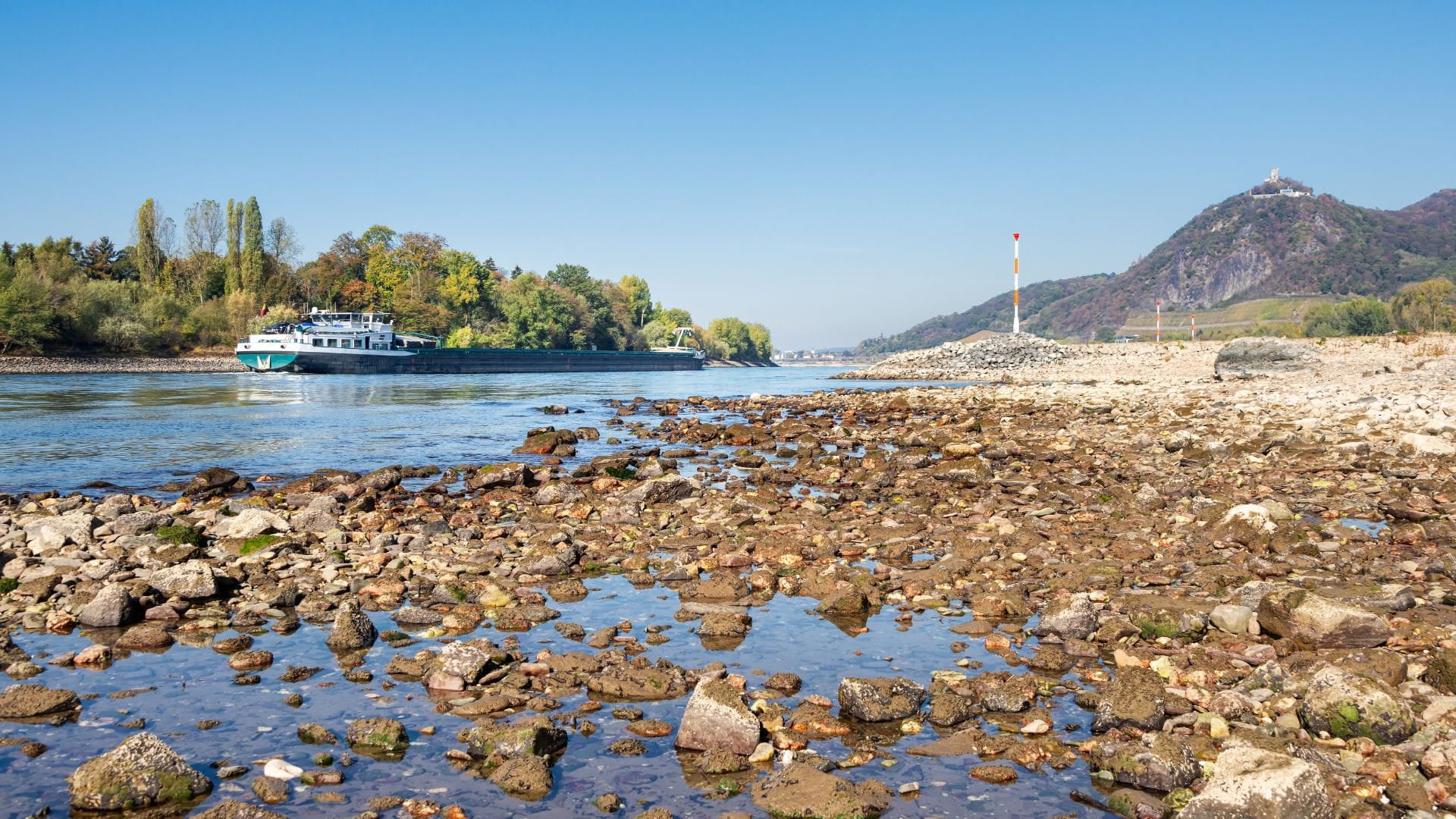
In early July 2026, the Rhine’s discharge at Lobith had already reached the official low-water threshold of approximately 1,020 m³ per second. By mid-July, the discharge had decreased further to below 750 m³/s, resulting directly in restrictions on shiploads. The situation looks like the notorious summers of 2018 and 2022, when extreme low water levels were registered. Ships were able to carry less cargo, logistics chains came under pressure and the economic consequences became immediately apparent.
Whereas such situations used to be exceptional, they now seem to be becoming an increasingly common feature of a changing climate. This raises a fundamental question: How do we ensure that the Rhine remains a reliable waterway and economic lifeline in the future?
Low water levels are no longer an isolated incident
The dry summers of 2018 and 2022 highlighted just how vulnerable the Netherlands is to extreme low water levels. This summer’s situation also demonstrates that low river discharges are not an isolated phenomenon.
Figures 1 and 2 show that prolonged periods with discharges below 1,020 m³/s at Lobith are not a new phenomenon. Between 1945 and 1980, these periods occurred regularly. From 1980 to 2014, however, prolonged low discharges were relatively rare. Since 2015, there has once again been an increase in the number of years with a relatively high number of prolonged low discharges.
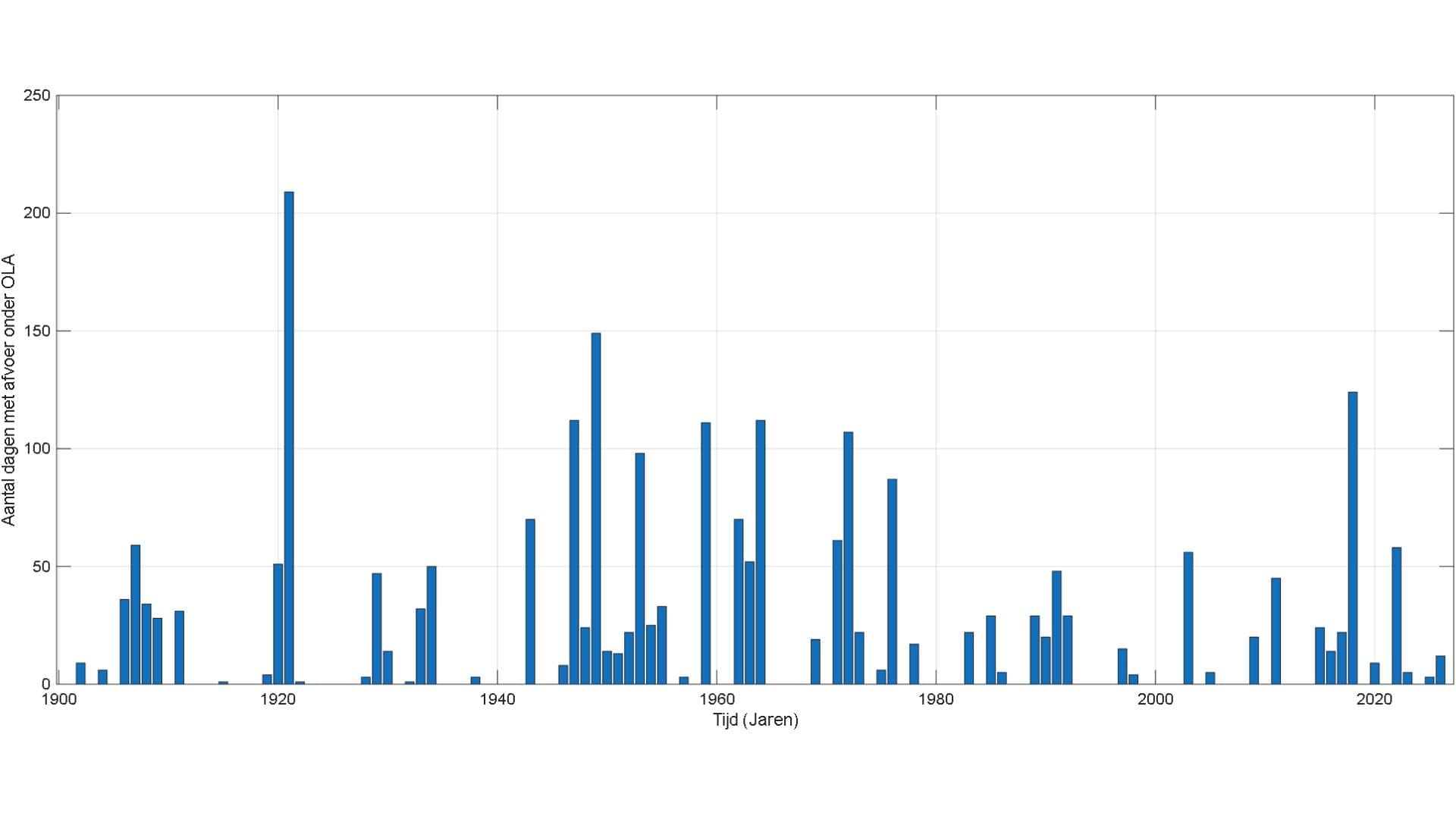
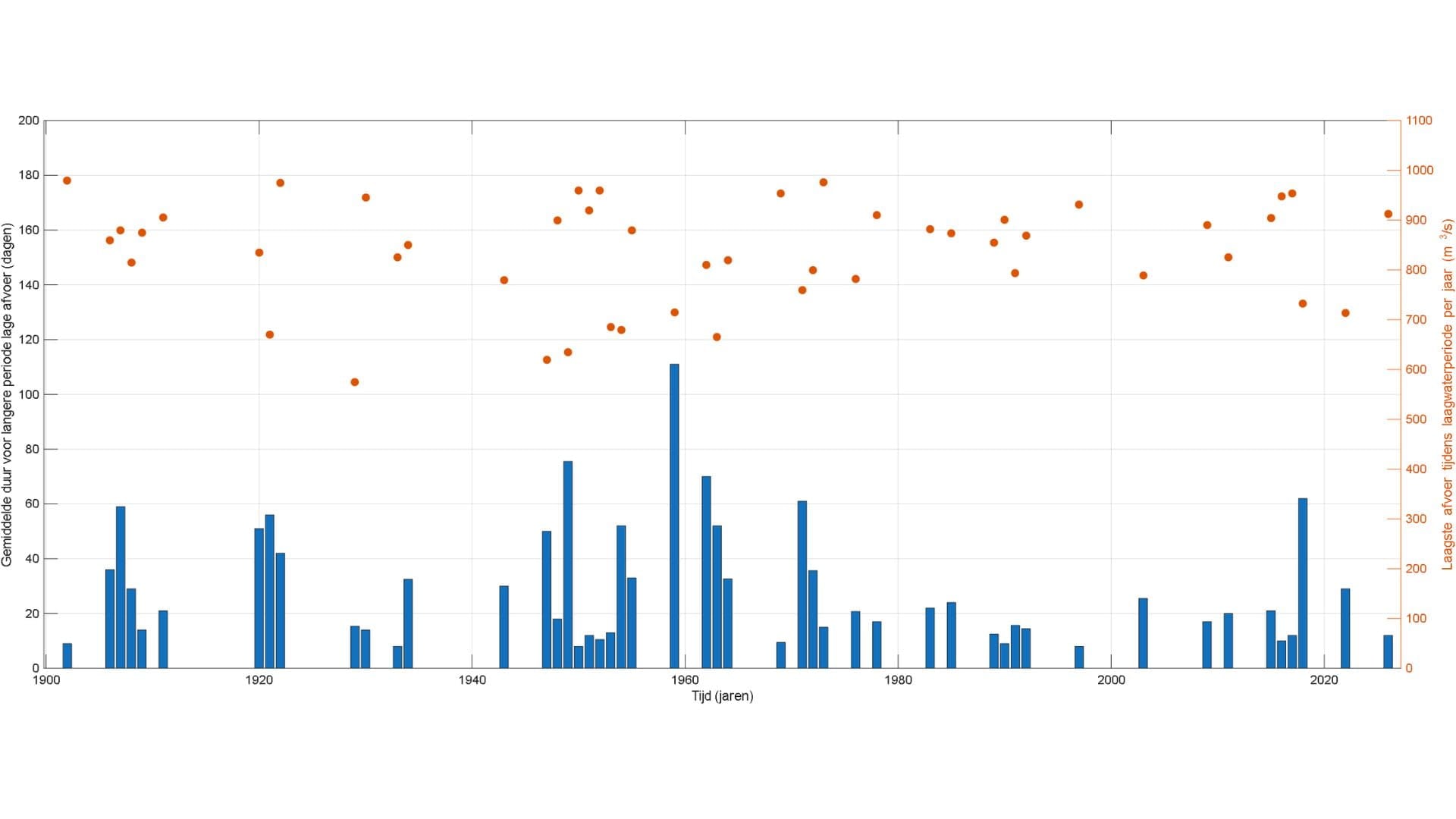
According to the KNMI’23 climate scenarios, prolonged dry periods are set to increase in both frequency and duration. At the same time, the flow regime of the Rhine is changing. Due to reduced snow storage and meltwater from the Alps, and a greater reliance on rainfall, average summer dicharges are decreasing, whilst average winter discharges are, conversely, increasing more frequently.
The question is therefore no longer whether periods of extremely low water levels will occur again, but how we prepare our river system and our economy for them.
The challenge lies not only in the climate
Climate change is only part of the story. Equally decisive is the way in which the river itself is changing.
Due to ongoing riverbed erosion in various sections of the Rhine, such as the Waal and the Upper Rhine, the riverbed has been eroding for decades. As a result, the same river discharge now leads to water levels that are many decimeters lower than in the past. Fixed structures such as cables, locks and hard riverbed layers do not sink with the riverbed, meaning that the available navigation depth at these locations is decreasing.
It is precisely this combination of climate change and river morphology that makes low water levels a complex systemic issue. A structural solution therefore requires more than just measures during dry summers.
A robust river system requires smart choices
To ensure the Rhine remains reliably navigable in the future, investment is needed in the river itself.
The Dutch government has recently decided to actively tackle riverbed erosion, including sand nourishment and the further development of a system of the so called ‘multiple channel’ system for the Waal. Sand nourishment makes up for the shortage of sediment, thereby slowing down further erosion of the riverbed. The ‘multiple channel’ system distributes the flow more evenly across the river. This reduces the erosive force, keeps the water level in the navigation channel higher, and creates a more stable balance between flow, sediment transport and ecology.
These measures demonstrate that river management is shifting from maintenance to adaptation: the river system is being adapted, step by step, to the climate conditions of the future.
Logistics must also become more resilient
A more robust river system alone is not enough. Users of the river will also have to adapt.
For logistics chains, this means that flexibility is becoming increasingly important. Companies will need to give greater consideration to multimodal transport strategies, in which inland waterway transport, rail and road complement one another. This will help reduce reliance on inland waterway transport during periods of extremely low water levels.
Although Rijkswaterstaat (RWS) and the German WSV can reliably forecast water levels up to fourteen days in advance using hydrological models, this information is not yet being utilised sufficiently within the logistics chain. As a result, the consequences of low water levels often only become apparent when there is little time left to anticipate them. This means that switching to a different mode of transport or adjusting logistics planning is often no longer possible, or only with great difficulty.
A joint challenge
Over the past few decades, the Netherlands has invested heavily in flood defences. This approach has resulted in a safe and manageable river system.
The challenge for the coming decades calls for a broader view of the river system. Flood protection remains as important as ever, but drought is also becoming a structural feature of our water system. This calls for an integrated approach that brings together hydrology, river morphology, infrastructure, nature and logistics.
The Netherlands is taking important steps in this regard, for example through measures to combat riverbed erosion. At the same time, the Rhine does not respect national borders. A resilient river therefore also requires cooperation with the upstream countries in the catchment area.
Only by investing jointly in a robust river system and resilient logistics chains will the Rhine remain the reliable economic lifeline of north-western Europe, even in a changing climate.

Want to know moreor got a question?
Contact our Climate Resilience experts!
