Indonesia's logistics backbone beyond container throughput

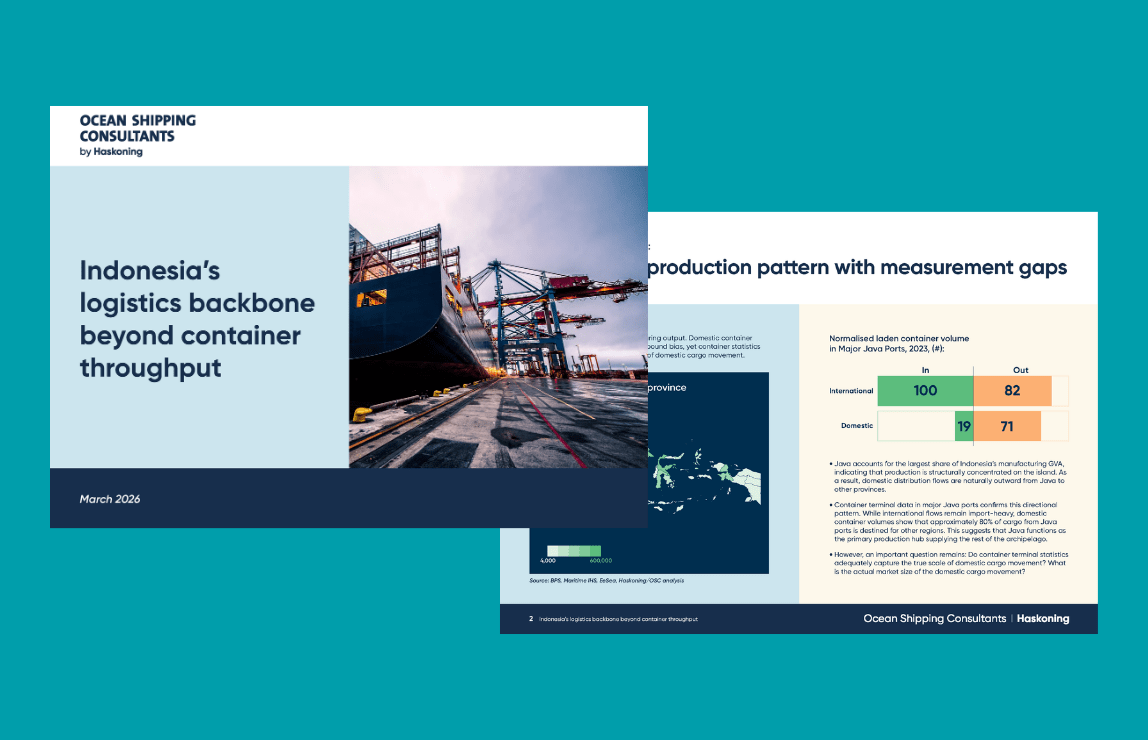
Container throughput is widely used to assess port activity and trade intensity. In Indonesia, however, a significant share of domestic cargo moves through truck–ferry networks rather than through container terminals.
Corridors linking Java with Sumatra, Bali and Nusa Tenggara handle freight through integrated road–ferry chains. Our analysis indicates that the Java–Sumatra corridor alone approaches ~1 million TEU equivalent of laden cargo annually—volumes that are not reflected in container throughput statistics.
Recognising both containerised and non containerised movements supports more accurate corridor planning, resilience thinking and long term infrastructure investment decisions—particularly where node capacity and disruption sensitivity can shape network performance.
Executive Summary
Indonesia’s domestic cargo system is structurally multimodal and extends far beyond container terminal activity.
Key insights from our latest market analysis include:
- Java dominates national manufacturing output, creating strong outbound domestic cargo flows.
- Domestic distribution is heavily dependent on truck and RoRo ferry corridors.
- The Java–Sumatra truck ferry route alone moves cargo equivalent to nearly 1 million TEU per year.
- These volumes are not reflected in container throughput statistics.
- Ferry nodes function as critical national logistics chokepoints.
- Infrastructure planning that relies solely on TEU risks underestimating the true scale of domestic cargo movement.
Our analysis demonstrates that Indonesia’s logistics backbone is larger and more complex than container data suggests.
Download the full report to explore the data, methodology and strategic implications in detail.
Indonesia’s logistics backbone beyond container throughput
About the author

IzzuddinBaqi
Izzuddin Baqi is a Consultant in Haskoning’s Ocean Shipping Consultants team, based in Jakarta, specialising in maritime business advisory, port feasibility, shipping and trade analysis, and financial modelling across Asia-Pacific. He delivers data-driven market studies and stakeholder-informed insights that support investment decisions for ports, terminals, logistics assets, and transport infrastructure.