How predictive simulation and digital twins work together to enable smarter decision-making

In our increasingly complex, data-driven world, harnessing the synergy between predictive simulation and digital twins is integral to driving day-to-day and long-term decision making. And the deep interconnection between the two sparked some interesting conversations at our Witness User Conference last year.
The central issue is no longer whether to use simulation, but how intuitively it can be embedded into daily workflows:
- What if building or updating a simulation model was as simple as feeding it the latest data?
- What if simulations could respond to daily operational challenges like resource and line optimisation?
- What if teams could talk to simulation models through an AI chatbot?
The answers point to a reality where predictive simulation and wider digital twin ecosystems work hand in hand – digital twins providing the dynamic real-world context, and simulation delivering the predictive intelligence needed to act with confidence.
How predictive simulation and digital twins complement each other
Predictive simulation and digital twins share an overarching purpose: helping organisations understand the physical world and shape it into the world they need for the future.
They change data into actionable insights so people can easily make better informed decisions that positively affect performance, sustainability, risk.
We (and Gartner) recommend thinking of digital twins as a capability staircase moving from descriptive to transformative, as shown in the image to the right.
Simulation comes into its own when you reach the Predictive, Prescriptive and Transformative stages of the staircase. That’s when you move beyond the current state to explore what-if scenarios, test decisions and predict outcomes before making changes in the real world.
Combined with machine learning, heuristic methods and other analytics technology, simulation acts as a predictive engine inside the digital twin.
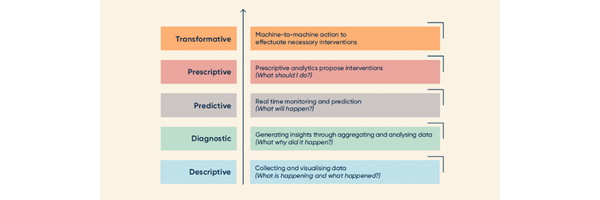
Thus, together, simulation and digital twins transform decision-making from reactive to proactive, unlocking value that neither can provide alone.
Demo: Digital twins and predictive simulation in action together
To illustrate the interplay, we created a demo using the example of a brewery, which handles malting, milling, mashing, boiling, fermentation and packaging.
- We started by developing a standard process flow using a basic simulation model using our Witness simulation modelling software.
- Then we broke it down into common elements including tanks, processes, buffers and logic-control machines.
- From there, we mapped the common elements to the ontology and constructed a knowledge graph by combining these building blocks with the simulation model. This allows the entire system to be represented in a unified knowledge graph. This representation – knowledge graph and ontology – is hosted on Azure Digital Twins.
Our use of the knowledge graph means we have ontology applied to a particular element – a specific tank represented in a certain stage of the process, for example. And we exported our Witness reference model, complete with modules, in an XML language.
- Next, we created a client app using a python application to interface in ADT. So now, if a change is made in the knowledge graph – updating the current fluid status, for example – the system automatically applies the change to the asset and process models. It then rebuilds the simulation model automatically from data using XML modules in Witness. And with standardised input parameters and user interface, it’s ready to run.
Many companies are now adopting this approach – the high-level workflow, along with a standardised way to represent the physical world – at enterprise level. It highlights the benefits of a reference standard model that supports creating, updating and managing simulation models.
Enabling smarter decision making
So, going back to our original questions. When digital twins and predictive simulation work in tandem, all three are not only possible, they’re within reach. Digital twins supply the structure while simulation delivers the insight, and together they create an end-to-end workflow.
- Digital twin models, built using standard languages, let us represent assets.
- Knowledge graphs cut the time and effort needed to build, update and maintain these models – and make it easier to feed them with live data.
- This strengthens simulation, enabling new use cases.
- And, with an ontology and knowledge graph in place, AI chatbots can help interpret outputs in natural language, as well as feed into machine learning and model refinement.
Ultimately, this approach makes insight accessible to decision makers, not just analysts. Plus, it positions simulation to work seamlessly alongside AI and other technologies across the wider digital twin ecosystem.
At Haskoning, our expertise spans all aspects of digital twinning, helping you better understand – and better interact with – the increasingly complex, fast-paced and data-driven world we live in. From consultancy to solution development, we help you maximise the synergy between predictive simulation and digital twins. Contact us today to find out more.